
Why it matters
The producer
Donovan Rall launched with Rall Red and Rall White after working and travelling at wineries in Europe and Australasia. The wines are not built around one estate: Rall works with growers, looking for grapes picked at suitable ripeness and balance. That model keeps vineyard choice at the centre of each release, from the Chenin-led White to Syrah drawn from Swartland schist.
The first Rall vintage in 2008 consisted of two wines, Rall Red and Rall White. By 2016, Rall began making single-varietal wines and became more directly involved with selected vineyards, rather than only purchasing grapes. The shift gave individual varieties and blocks more room in the range: Syrah could be bottled on its own, while the AVA wines grew from two schist-grown vineyards near Riebeek that Rall considered capable of standing alone.
Place and vineyards
Where the wines begin
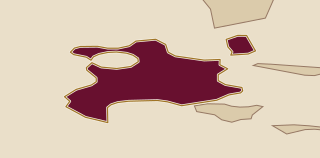
The Swartland is the strongest thread in Rall’s early wines: ten vineyards, predominantly there, supplied the original red and white blends. Stellenbosch also contributes fruit to the wider sourcing model. In the glass, this spread of places is most useful as a way to read the labels: the blends assemble varieties and vineyards, while bottlings such as Rall Syrah 2022 bring one grape and a Swartland soil into closer focus.
For the first two blends, decomposed granite was associated with the white and schist with the red. Those are historical associations, but they frame the later Syrah clearly: Rall Syrah 2022 comes from schist in the Swartland. Its stony plum and thorny savoury notes sit alongside medium body and grippy tannin, showing why the ground is more than a back-label detail.
In the cellar
Vineyards and cellar
Rall reports limited sprays in the vineyards but has not pursued formal certification. Soil type and vine age guide the selection, while closer management of chosen blocks supports the old-vine material growers are preserving. In the cellar, natural fermentation and vessels including concrete, cask and amphora are used according to the wine. Rall White 2021, for example, fermented and matured by component for ten months in seasoned French oak and concrete before blending, a method that builds texture without putting overt oak flavour in front of the fruit.
Wines to know
The range in view
The range began as two blends. In a 2019 account, Rall White combined Chenin Blanc, Verdelho and Viognier, while Rall Red combined Shiraz, Carignan, Grenache and Cinsault. Rall White 2021 keeps that white-blend logic in a documented composition of 68% Chenin Blanc, 28% Verdelho and 4% Viognier: Chenin carries the frame, with Verdelho and Viognier widening the fruit and floral register.
The later varietal wines narrow the frame. Rall Syrah 2022 is early-picked, fermented with native yeasts as whole clusters, then matured in concrete; it is slender and medium-bodied, with plum, wild raspberry, purple flowers, rooibos tea and pepper. Ava Syrah 2022 is also 100% Syrah, but its large-foudre maturation accompanies a more savoury profile of red and black berries, orange, rose, lavender, fynbos and dark spice, ending dry and long.
A useful way in
A bottle to begin with
Choose Rall Syrah 2022 first. It brings together the documented Swartland schist source, early harvest, native whole-cluster fermentation and concrete maturation in one bottle. Expect medium body rather than dense weight: stony plum, raspberry, purple flowers, rooibos and pepper lead into fine, grippy tannin and a dry finish. It shows how a single-varietal Rall wine can hold both floral lift and savoury grip without leaning on oak.