
Why it matters
The producer
Diego Rallo started trading wine in 1851 and founded his winery in 1860. Within a generation, his Marsala and Passito di Pantelleria had reached merchants in Europe and the Americas. For over a century the Rallo name meant fortified wine from the western tip of Sicily.
In 1996, Andrea and Francesco Vesco bought the estate and changed its direction. The Vesco family had farmed Sicilian land since Benedetto Vesco purchased plots at Pattipiccolo on 8 May 1920. What the brothers brought to the acquisition was not just capital but a working Alcamo hill vineyard and a clear commitment: dry whites from estate-grown grapes, not sweet wines from bought-in fruit. The historic Marsala cellars stayed in use; the production logic shifted entirely.
Place and vineyards
Where the wines begin
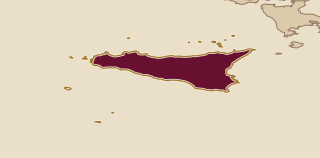
Western Sicily runs from the Alcamo hills down to the Marsala coast and then across open sea to Pantelleria, a volcanic island closer to Tunisia than to Palermo. Rallo's vineyards span all three, and each zone produces differently.
Alcamo sits inland, with vineyards climbing between 230 and 600 metres above sea level on clay-rich hill soils. The elevation slows ripening through Sicily's punishing summer heat and preserves acidity in the grapes long enough to make dry whites worth drinking. Without that altitude, Catarratto and Grillo would give flat, heavy wine.
In the cellar
Vineyards and cellar
The Alcamo vineyards are farmed without synthetic inputs under BioSuisse certification. Vine density and training are adjusted by variety and slope, with the aim of controlled yield and even ripening. Harvest is selective.
In the cellar, stainless steel is the default vessel, used to retain freshness and aromatics. Minimal intervention is the stated philosophy.
Wines to know
The range in view
The range divides into four clear types.
The dry whites from Alcamo and Marsala are built on Catarratto, Grillo, and Insolia. These are clean, stainless-steel whites aimed at the table: bright citrus from Catarratto, a rounder, more textured character from Grillo, and the softer mid-palate contribution that Insolia adds to blends. Acidity is their main structural asset, driven by Alcamo's elevation.
A useful way in
A bottle to begin with
Amber One Catarratto is the wine that shows most clearly what the estate has become since 1996. It is Catarratto from the Alcamo hills, fermented spontaneously on its skins for three days, then vinified in stainless steel. The skin contact turns the wine golden, pulls a light tannin grip into the mid-palate, and gives the finish a mild, saline mineral edge. It is dry, slightly grippy, with citrus and dried apricot sitting in the same glass. No oak, no residual sweetness.