
Why it matters
The producer
Roccheviberti sits in the village of Rocche within the commune of Castiglione Falletto, a Langhe hill town whose name appears on some of the most sought Barolo in the appellation. The estate is small: 4.5 hectares of Nebbiolo, Barbera, and Dolcetto spread across three named crus. The Viberti family has farmed these parcels since 1946, and Claudio Viberti, the third generation to tend the vines, released his first vintage under the Roccheviberti label in 2003.
What makes the estate worth understanding is not scale but geometry. Two of its three crus, Rocche di Castiglione and Bricco Boschis, face different directions, sit at different altitudes, and carry soils so unlike each other that Claudio eventually decided the only honest thing to do was bottle them separately. A drinker who opens both bottles from the same village, the same grower, and the same vintage is tasting the Langhe's geological argument with itself.
Place and vineyards
Where the wines begin
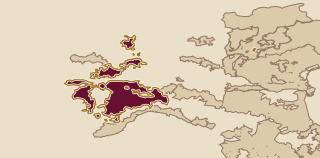
Castiglione Falletto occupies a central position in the Barolo zone, physically and stylistically. The village sits between the heavier clay and limestone of Serralunga to the east and the more calcareous, sand-mixed soils of La Morra to the west. Barolo's legal production area covers eleven communes, and Castiglione Falletto produces wine that sits between those two poles: enough grip for ageing, enough aromatic lift to drink sooner than a pure Serralunga.
Roccheviberti's two primary crus each pull in a different direction. Rocche di Castiglione rises to 300-350 metres with an east-southeast exposure, catching the morning sun. Bricco Boschis faces west at 200-300 metres. The altitude difference is modest; the soil difference is not. Rocche carries limestone with sand and tuff. Bricco Boschis carries heavy clay. Those two substrates translate directly into two distinct Barolo profiles, and the range is built around that fact.
In the cellar
Vineyards and cellar
All the Nebbiolo at Rocche di Castiglione goes to Barolo. The vines are mature, averaging 40 years, and the cru's steep slopes mean low natural yields. Fermentation happens in temperature-controlled steel tanks, which preserves the aromatic character that limestone-and-tuff Nebbiolo develops. Ageing moves to French oak barrels. The approach keeps the cellar from adding flavour on top of the vineyard: oak provides oxygen exchange and gradual tannin softening rather than vanilla or toast character.
The Langhe Nebbiolo, the entry wine in the range, ages 18 months in French oak casks and at least 6 months in bottle. That extended wood contact gives a wine at this level more presence than a quick-aged Nebbiolo, though it stays lighter and less concentrated than the single-cru Barolos.
Wines to know
The range in view
The range has five labels, and the architecture follows the crus rather than a hierarchy of price alone.
Barolo Rocche di Castiglione is the estate's most aromatic wine. Nebbiolo from the limestone-and-tuff hillside at 300-350 metres produces a Barolo with clear cherry and dried rose on the nose, a mid-palate that is firm but not heavy, and tannins that resolve to a silky finish earlier than the clay-grown wines. The east-southeast exposure means morning sun and cooler afternoons, preserving acidity and fragrance.
A useful way in
A bottle to begin with
Start with the Barolo Rocche di Castiglione. It is the wine the estate is named for: Nebbiolo from forty-year-old vines on the limestone-and-tuff hillside that defines the village of Rocche. Fermented in steel to preserve aromatic clarity, aged in French oak for gradual softening, it arrives in the glass with dried rose, cherry and a fine, precise acidity that carries the wine through a long finish. The tannins are real but not punishing, and the wine is approachable within a reasonable number of years. Rocche di Castiglione is where Castiglione Falletto's middle character, between Serralunga grip and La Morra perfume, is most legible in a single bottle.