
Why it matters
The producer
Ruppertsberger Weinkeller Hoheburg is a registered winegrowers’ cooperative headquartered at Hauptstr. 94 in Ruppertsberg. The present organisation dates from 1968, when two cooperatives with roots in the 1910s joined together. Riesling is its central grape, accounting for more than 45 percent of the cultivated area; that concentration puts lime, stone fruit, floral notes and acidity at the centre of bottles such as Imperial, Nussbien and Hofstück.
The cooperative brings together 86 winegrowers. Their fruit supplies a white-wine-majority portfolio, while Pinot Noir, Scheurebe, Silvaner, Müller-Thurgau, Grauburgunder, Dornfelder and Lemberger widen the offer. The consequence is a range with several routes through Pfalz grapes: aromatic whites, Rieslings with differing sweetness levels, and reds alongside them.
Place and vineyards
Where the wines begin
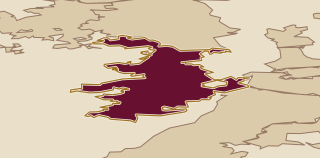
Ruppertsberg is the home address, but the grower vineyards extend beyond it into Königsbach, Mußbach, Meckenheim and Deidesheim. That five-community footprint matters in a cooperative: Riesling from more than one local setting can be assembled into a recognisable house range, while bottles carry their own names and styles rather than claiming to speak for one documented parcel.
Pfalz is the regional frame on the label and in the glass. Here, the most useful connection is practical: Riesling is grown at scale across the cooperative’s area, then appears as a very fresh Imperial Riesling, a slightly sweet Kabinett and an off-dry Hofstück. The same grape becomes different bottles through style and composition, not through unsupported claims about individual sites.
In the cellar
Vineyards and cellar
The cooperative markets wine from a large vineyard base, though the available figures describe different scopes: the regional directory reports approximately 500 hectares marketed annually, while FAIR’N GREEN reports around 600 hectares through direct sales, specialist and food retailers, and exports. Those figures should not be collapsed into one number; they do show why the range can cover several grapes and styles.
One cellar detail is firmly tied to one wine. The boxed Imperial Riesling 2025 was fermented and matured in temperature-controlled stainless-steel tanks, a method that keeps the grape’s green apple, peach, pear and lemon profile in the foreground rather than adding oak flavour. It should not be treated as a description of every wine the cooperative makes.
Wines to know
The range in view
Riesling is the structural centre of the range. Imperial Riesling 2025 is described as very fresh, with pear, honey, pineapple, white flowers and lime: a fruit-and-floral style where citrus keeps the palate moving. Its boxed counterpart is a separate 2025 release, made in stainless steel and marked by green apple, peach, pear and lemon.
Nussbien Riesling Kabinett 2025 moves toward slight sweetness. Pear, honeydew melon, white peach, elderflower and lime give it a softer fruit profile, while mineral notes and citrus prevent the sweetness from becoming heavy. Hofstück Riesling is 100 percent Riesling and off-dry, with lively acidity, apricot and citrus; it is listed for drinking now or for one to three years of ageing.
A useful way in
A bottle to begin with
Choose Ruppertsberger Hofstück Riesling first. It is 100 percent Riesling, off-dry, fresh and fruity, with lively acidity and a clear apricot-and-citrus profile. That pairing makes the bottle especially useful: the small amount of sweetness broadens the fruit on the palate, while acidity keeps the finish bright rather than syrupy.