
Why it matters
The producer
Stephen Pannell is co-owner and winemaker. Before starting the label with Lindquist, he worked in Burgundy, Bordeaux and Barolo, then spent a decade at BRL Hardy, mostly as Chief Red Winemaker. That route leads to a producer whose wines move between Italian varieties, Grenache and Australian Shiraz, with vineyard name and grape carrying as much meaning on the label as the regional address.
Pannell and Lindquist established S.C. Pannell after Stephen Pannell’s work in European regions and at a large Australian winery. They then became custodians of four vineyards, acquired gradually over nine years. The decisive move was toward a small collection of site-led grapes: Nebbiolo where it had proved successful at Protero, Grenache at Blewitt Springs, Aglianico at Olivers Road and Shiraz at Upper Tintara. That structure allows a South Australian range to include red wines with different bodies, tannin profiles and food roles.
Place and vineyards
Where the wines begin
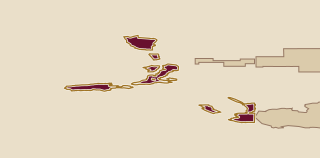
South Australia is the shared frame, but the wines are spread across distinct named places. Adelaide Hills is paired with Nebbiolo at Protero; Blewitt Springs with Grenache; Olivers Road with Aglianico; and Upper Tintara with Shiraz. A bottle therefore begins with a practical question: which grape is planted at which site? Koomilya answers it most directly, as an Upper Tintara single-vineyard Shiraz.
The estate’s site information is expressed through those vineyard names and grape choices rather than a detailed account of soil, slope or elevation. That makes the bottle names useful: Protero points to Adelaide Hills Nebbiolo, while Koomilya points to Upper Tintara Shiraz. The range asks the glass to show differences between places through variety, fruit shape, tannin and weight, rather than through a generic South Australian house style.
In the cellar
Vineyards and cellar
The 2021 Old McDonald Grenache shows the cellar work in unusually clear detail. Fruit fermented in a stainless-steel open-top fermenter with regular pump-overs and 20% whole bunches, then remained on skins for 15 days before gentle pressing. After 20 days settling in tank, the wine went to an old French-oak vat for malolactic fermentation. Open-top handling and skin contact keep the Grenache’s juice in contact with skins for colour and tannin; whole bunches can bring a lifted, spicy edge, while old oak is less likely to cover the fruit with overt new-oak flavour.
Wines to know
The range in view
The range is organised as a series of vineyard-and-grape propositions. Protero is the Adelaide Hills branch, where Nebbiolo shaped the vineyard’s varietal direction; expect a grape associated with firm tannin and acidity rather than a broad, soft red. Olivers Road carries Aglianico, another variety valued for structure and savoury depth. Blewitt Springs provides Grenache, including the single-vineyard Old McDonald release, where open-top fermentation, whole bunches and 15 days on skins build texture around the fruit.
Upper Tintara is the Shiraz address. Koomilya is presented as its single-vineyard expression and sits within the tradition of Australian Shiraz, so it belongs at the more structured, darker-fruited end of the collection. Dead End McLaren Vale Tempranillo adds another red-wine route: its name and vineyard account identify Tempranillo, a grape whose moderate body and savoury tannin offer a different shape from Shiraz or Grenache.
A useful way in
A bottle to begin with
Start with the 2021 Old McDonald Grenache. It is a single-vineyard Grenache with a documented sequence of stainless-steel open-top fermentation, regular pump-overs, 20% whole bunches, 15 days on skins, gentle pressing and malolactic fermentation in an old French-oak vat. In the glass, look for red-fruit aroma, whole-bunch spice, dry tannin and a textured finish rather than a heavy oak profile. It puts Grenache, vineyard specificity and a concrete cellar method in one bottle.