
Why it matters
The producer
Mathieu Manifacier is the third-generation winemaker at Berguerolles, where the family makes IGP Cévennes and Vin de France wines beside the Cèze river. Sauvignon Blanc, Syrah and Grenache sit alongside Serine, Souvignier Gris, Floréal and Italia Bouquet; that planting range allows Le Clos Blanc to remain a structured dry white while other labels explore orange wine, rosé and sparkling wine.
Robert Saint-Étienne acquired Clos de Berguerolles in 1967 and rebuilt the vineyard. Estate bottling followed in 1974, establishing a family label where the fruit had previously not been bottled under the domaine’s own name. The third generation has kept that estate framework while widening the cellar’s vocabulary: classic regional grapes remain in Le Clos Rouge, while Serine, hybrid varieties, zero-added-sulfur bottlings and pét-nat introduce different fruit, texture and fermentation profiles.
Place and vineyards
Where the wines begin
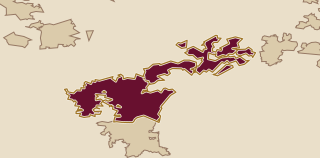
Saint-Ambroix lies in the northern Languedoc, at the edge of the Cévennes. Berguerolles’ hillside runs beside a bend in the Cèze, whose meander creates a local microclimate that protects the vines from Cévennes climatic hazards. For grapes such as Sauvignon Blanc and Petit Manseng, the site supports the freshness and citrus lift found in Le Clos Blanc; for the red and natural-wine range, it leaves room for aromatic varieties to ripen without forcing every bottle into the same shape.
The vineyard has red clay over silt, with quartz and granite pebbles in the ground. Those soils are spread across a hillside rather than a single uniform parcel, which suits the domaine’s mixed plantings: white grapes can be directed toward dry, lees-aged wines, while varieties such as Syrah, Serine and Cinsault feed red and rosé bottlings. The result is a range built from several grape and soil combinations, not a single estate recipe.
In the cellar
Vineyards and cellar
Organic viticulture and more than 20 grape varieties provide the raw material; cellar decisions then separate the wines. For Le Clos Blanc, grapes are harvested at night, gently pressed and cold-settled for 72 hours before fermentation in French oak and acacia barrels. Nine months on fine lees add body and a creamier texture to a wine whose Sauvignon Blanc component still carries citrus and white fruit.
Back to the Serine takes a different route. The Serine grapes are hand-picked, fermented whole-bunch with indigenous yeast and held for nine months in stainless steel. Without barrel ageing, the red’s blackcurrant-bud, wild-strawberry, fennel and black-tea character stays in the foreground, with herbal lift and a lighter oak imprint. La Vie en Orange uses Sémillon and Viognier with eight days of skin maceration, drawing gentle tannic grip from the grape skins.
Wines to know
The range in view
The range has an established core in Le Clos Blanc and Le Clos Rouge. Le Clos Blanc changes with the vintage: documented versions include Sauvignon Blanc with Petit Manseng and Gros Manseng, a pure Sauvignon Blanc release, and a Sauvignon Blanc–Petit Manseng blend. Barrel fermentation and lees ageing give the white dry weight, citrus fruit and a measured oak note. Le Clos Rouge combines 80% Syrah, 15% Grenache and 5% Cabernet Sauvignon, bringing dark fruit, spice, tannin and fuller red-wine body.
Beyond those wines, Back to the Serine focuses on the ancestral pre-clonal relative of Syrah. White Rabbit uses a changing set of varieties in available records, including Souvignier Gris, Floréal and Gros Manseng; its citrus, floral notes, stone fruit and saline edge place it nearer the domaine’s exploratory whites. Pink My Ride is a direct-press Cinsault and Cabernet Sauvignon rosé. Pét-nat appears in white and rosé versions, while La Vie en Orange supplies skin-contact texture and dry grip.
A useful way in
A bottle to begin with
Start with the current vintage of Le Clos Blanc, checking the label for its exact grape blend. It is the bottle where the Cèze-side site, the estate’s established white-wine work and its deliberate cellar method meet: Sauvignon Blanc supplies citrus and freshness, Manseng varieties may add apricot and breadth, and nine months on lees in oak and acacia barrels add dry texture and a gentle vanilla note. It is a useful first taste because the wine changes its blend by year while retaining a clear, dry, structured shape.