
Why it matters
The producer
SCEA Terres Bordelaises is the name behind a collection of Bordeaux château labels rather than one estate bottled under one name. That structure matters at the table: Château Timberlay, Château Saint Robert and Château Bordenave are different wines with different grapes, appellations and levels of sweetness, even though they are linked by the same producer. The label is therefore the useful starting point; it tells you which part of the portfolio is in the bottle.
Terres Bordelaises is best understood through the movement between its labels. Guide Hachette names Bastor-Lamontagne, Saint-Robert, Faizeau, Haut-Mouleyre, Laubès, Timberlay, Bois Pertuis, Colombier, Courteillac and Étalon d'argent in the Gironde portfolio. That breadth creates a range in which a dry Sauvignon Blanc Bordeaux, a Sauvignon Blanc–Sémillon Graves and a sweet Sauternes do not need to perform the same job. The producer name connects them; the château name and appellation describe the style waiting in the glass.
Place and vineyards
Where the wines begin
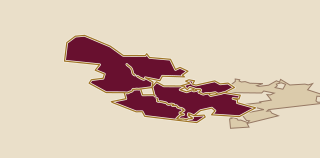
The documented addresses run through Bordeaux and Gironde, with Landiras as the recorded address for SCEA Terres Bordelaises. On the bottle, Bordeaux and Graves do more than name a broad area. Château Timberlay 2022 is a dry Bordeaux white made from Sauvignon Blanc, while Château Saint Robert 2022 is a Graves white built from Sauvignon Blanc and Sémillon. Château Bordenave is Sauternes: its 81 grams of sugar per litre place it in a distinctly sweet, full-bodied register.
The available château records do not attach Timberlay, Saint Robert or Bordenave to named parcels, slopes or soil types. The exception is Château Bastor-Lamontagne at Preignac in Sauternes, where 53 hectares of sandy gravel and clay-limestone ground are recorded. Its 76% Sémillon and 24% Sauvignon Blanc blend is aged for 12 to 18 months, including 30% new barrels, so the site and cellar are documented together in a sweet-wine bottle rather than assumed across the wider portfolio.
In the cellar
Vineyards and cellar
The farming detail is bottle-specific. Château Timberlay 2022 was recorded as undergoing organic conversion, while Château Saint Robert 2022 was recorded as organic. Château Haut-Mouleyre 2019 gives a further white-wine example: 70% Sauvignon Blanc and 25% Sauvignon Gris, with oak used in the wine. For Bastor-Lamontagne, the long barrel ageing and 30% new oak give a documented route to a broader texture in its Sauternes; that information should not be carried over to the fresh dry whites without a matching record.
Wines to know
The range in view
The range has several clear lanes. Timberlay 2022 is dry Bordeaux blanc made from Sauvignon Blanc; Saint Robert 2022 adds Sémillon to Sauvignon Blanc under the Graves appellation. Haut-Mouleyre 2019 combines Sauvignon Blanc and Sauvignon Gris with oak, making it a separate white-wine proposition from the unoaked status that cannot be presumed for Timberlay. Château Bois Pertuis supplies a Bordeaux red entry and received silver at the 2025 Concours de Bordeaux.
At the sweet end, Château Bastor-Lamontagne is Sauternes, with Sémillon in the leading role and barrel ageing of 12 to 18 months. Château Bordenave, another Sauternes recorded under SCEA Terres Bordelaises, is nearly evenly split between Sauvignon Gris at 52% and Sémillon at 48%. Its 13% alcohol, 81 grams per litre of sugar and 3.2 grams per litre of acidity point to a wine with weight and sweetness rather than the dry citrus profile associated with the Bordeaux blanc labels.
A useful way in
A bottle to begin with
Begin with Château Bordenave 2019 Sauternes. It makes the portfolio’s breadth immediately physical: a sweet Bordeaux white made from 52% Sauvignon Gris and 48% Sémillon, at 13% alcohol with 81 grams per litre of sugar. Apricot, mango and honey lead into a full, soft palate, and the recorded acidity gives the finish some lift. It is the bottle that most plainly shows why the producer name alone is not a style statement: under Terres Bordelaises, a château label can lead to a sweet, mature-fruited Sauternes as readily as to a dry Sauvignon Blanc Bordeaux.