
Why it matters
The producer
Michael is the owner and inspirer at Château Bonnange, while Franck leads general management and sales and Paul-Emmanuel Boulmé directs the technical side. Boulmé has made the wines for two decades, so the estate’s current bottles join a long cellar hand to a vineyard programme that separates grapes and parcels instead of folding every crop into one blend.
Claude Bonnange, founder of TBWA, acquired the vineyard in 1999 after choosing Blaye’s terroirs for a wine project. He brought Paul-Emmanuel Boulmé of Château Terre-Blanche into the winemaking, and the estate now carries that decision forward through natural-yeast fermentations, small lots and several ageing vessels. The range therefore does not stop at a conventional Bordeaux blend: it also isolates Merlot, Cabernet and Cot, then places individual grapes on selected soils.
Place and vineyards
Where the wines begin
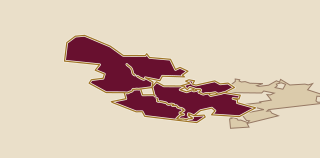
Saint-Martin-Lacaussade sits in the Blaye area of Bordeaux, and Château Bonnange works with both Bordeaux and Blaye-Côtes-de-Bordeaux wines. That dual address matters on the label: Bordeaux blending provides the familiar Merlot-and-Cabernet framework, while the Blaye parcels supply the limestone-and-clay ground used for the estate’s more grape-specific bottlings.
The vineyard is divided among limestone-and-clay terroirs rather than treated as a single block. Its vines average about 30 years old, and some plots are more than a century old; those older plantings bring established root systems into the fruit supply, which makes parcel-by-parcel handling in the cellar a practical choice rather than decoration.
In the cellar
Vineyards and cellar
Organic conversion is under way in the vines, where limestone-and-clay parcels and old plots are worked as distinct sources of fruit. In the cellar, natural yeasts and small-lot fermentation keep those sources separate before ageing. That sequence allows a Merlot parcel, a Cabernet parcel or a blended lot to retain its own fruit, tannin and weight before oak or another vessel shapes the finish.
Wines to know
The range in view
The Château Bonnange wines present the estate’s blended Bordeaux side, while Le Clos de Bonnange provides a named red with a documented structure of 80% Merlot, 15% Cabernet Sauvignon and 5% Malbec. Its 18 months in oak put fruit, tannin and oak on the same frame: Merlot supplies the broad central body, Cabernet Sauvignon contributes firmer grip, and Malbec adds another dark-fruit register.
Petit Merle, Le Cab and Cot move from blending toward single-variety expression. Alongside them are three wines that pair individual grapes with specific limestone-and-clay soils. The range can therefore be approached by structure: blend for layered body and tannin, varietal bottlings for a more direct grape profile, then soil-matched wines for how ground changes fruit and texture.
A useful way in
A bottle to begin with
Start with Le Clos de Bonnange, using the documented 2016 bottling as the reference: 80% Merlot, 15% Cabernet Sauvignon and 5% Malbec, aged for 18 months in oak. It brings the estate’s Bordeaux blend into one glass, with Merlot body, Cabernet tannin, Malbec dark fruit and oak spice gathered into a dry red with weight and a firm finish. The single-variety wines become easier to place after tasting this blended foundation.