
Why it matters
The producer
Al Scheid founded the business in 1972 as a strategic investment. It remains family stewarded and operates from grapes to glass: vineyard ownership and growing sit alongside winemaking and finished-bottle production. For a bottle carrying the Scheid name, that structure connects the decisions made across the estate’s long vineyard corridor with the wine produced at the family’s own facility.
Scheid began as a grape-growing operation, founded by Al Scheid in 1972, then grew into a family-run wine business with control over both vineyard fruit and finished bottles. The company’s own winemaking facility, built in 2005, put production alongside a farming operation already working across several climate zones. The Scheid Vineyards label, launched in 2011, turned that combined vineyard and cellar structure into bottles sold under the family’s name.
Place and vineyards
Where the wines begin
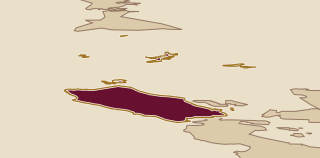
Scheid’s California footprint is spread across Monterey County rather than concentrated around one named vineyard. Its vines sit between the Gabilan and Santa Lucia ranges in four climate zones; this geographic spread is the practical reason the estate can match many grapes with different growing conditions. A variety intended to retain acidity need not be treated like one grown for colour extraction, and the range begins with those separate vineyard placements.
No named soil profile or slope-by-slope classification is established here. The grounded site story is farming: cover crops are planted for soil health, weed suppression and erosion control, while grape pomace returns to the vineyards as fertilizer. Those are recurring vineyard inputs rather than a cellar treatment, supporting the ground in which the estate’s broad grape range is grown.
In the cellar
Vineyards and cellar
More than 35 grape varieties are grown across the estate, with each placed in an environment selected for varietal intensity, acidity and colour extraction. This is a vineyard-led way of building range: the choice starts with where a grape is planted, then carries into the winery rather than asking one climate zone to deliver every kind of fruit.
The family’s facility allows those grapes to move into winemaking within the same integrated operation. The supplied record does not establish individual fermentation, oak or lees regimes, but it does establish the structural link: fruit from a wide set of sites and varieties is brought into a winery built by the family, then released under its own label.
Wines to know
The range in view
The supported picture is a broad, site-matched range rather than a single wine. Scheid grows more than 35 varieties across four climate zones, selecting locations for varietal intensity, acidity and colour extraction. In wine terms, acidity is a stated structural aim, while colour extraction points to grapes and sites intended to deliver depth of hue; the range’s architecture begins in the vineyard before any bottle is chosen.
The Scheid Vineyards label dates from 2011. No named cuvée, grape composition, appellation or bottle-level tasting note is established in the supplied record, so it would be misleading to invent a hierarchy among the wines. What is clear is the estate’s scale of choice: different grapes can be grown for different structural outcomes, then made within the same family-run operation.
A useful way in
A bottle to begin with
Start with a bottle carrying the Scheid Vineyards label and use the grape named on that bottle as the first guide. The label is the family’s own wine label, launched in 2011 after its 2005 winery was built; it therefore joins the estate’s vineyard work to the finished wine. Compare the wine’s acidity, fruit weight and colour with its grape and label details, rather than expecting one unverified flavour profile to stand for a range grown across four climate zones.