
Why it matters
The producer
In 1171, Cistercian monks spreading out from Burgundy across Central Europe were donated their first vineyards at Gobelsburg, in what is now the Kamptal wine region of Lower Austria. The estate has produced wine ever since, making it the oldest documented winery in the Danube region. The castle and grounds passed through various aristocratic families before Zwettl Abbey acquired them in 1740, and the monks have held legal title ever since. Active winemaking control moved to Eva and Michael Moosbrugger in 1996, though the monastic ownership continues.
The Moosbruggers brought a clear farming ambition: vineyard work done by hand, mostly following organic practice, and a range organised around Kamptal's named parcels. Grüner Veltliner makes up half of total production, with Riesling accounting for a further quarter. The estate specialises in Rieslings made by traditional methods, alongside the whites and reds that fill out the Domaene Gobelsburg tier.
Place and vineyards
Where the wines begin
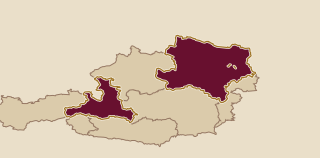
The Kamptal runs north from the Danube along the river Kamp, in Lower Austria. Gobelsburg sits roughly 80 kilometres northwest of Vienna, where a continental climate gives hot summers and cold winters and the diurnal swings that keep acid intact in both Grüner Veltliner and Riesling. The named vineyard sites cluster along the slopes above the valley, each with its own geology and exposure.
Zöbing, to the north, is the home of the Heiligenstein, a south-facing slope of ancient volcanic origin. Renner sits below on clay and loam. Lamm is a loess and loam parcel producing Grüner Veltliner with a richer, fuller character than the stonier sites.
In the cellar
Vineyards and cellar
The estate covers 75 to 83 hectares, farmed by hand and following organic practice, though as of 2022 the vineyards carried no official organic certification. Grüner Veltliner takes up half the planted area, Riesling a quarter. The red varieties, St. Laurent, Zweigelt, Pinot Noir and Merlot, make up the remaining quarter, with St. Laurent the largest at 8% of total production.
Rieslings are made by traditional methods, the specific focus the estate identifies as its signature. Across the range, the farming intention is consistent: hand work in the vines, limited additions, and a respect for what individual parcels express.
Wines to know
The range in view
The range runs across three broad tiers. The Domaene Gobelsburg label covers entry-level wines including a Kamptal Grüner Veltliner, a Zweigelt and a rosé. The Grüner Veltliner is fresh and pepper-edged, lighter in body than the estate's named-site wines, with citrus and herb notes and a clean finish. The Zweigelt is red-fruited and relatively light in tannin, built for early drinking.
Mid-range parcels such as Steinsetz and Zöbing Riesling step up in site specificity. The Steinsetz shows more mid-palate weight than the entry-level whites. The Zöbing Riesling has stone fruit and firm acidity, a recognisable Kamptal character without the concentration of the top sites.