
Why it matters
The producer
Jean Paux-Rosset and Claude Gros bring together participating estates from Minervois, Faugères, Corbières, La Clape and Côtes du Roussillon. Gros works with the estates through the growing season, while the labels preserve the individual château or winery name; the result is a range where appellation remains a useful guide to what is in the bottle.
This is not a portfolio to reduce to one grape formula. Château Rigaud is a small Faugères estate making an organic red blend, La Rougeante is a Corbières wine built from four southern grapes, and Château Tendon carries Saint-Chinian and schist in its frame. The Select Vins name links the wines, but the estate and appellation names tell the more immediate story.
Place and vineyards
Where the wines begin
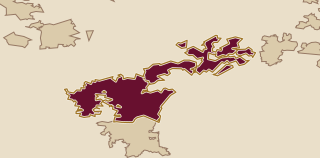
The portfolio stretches across several Languedoc appellations, from Minervois and Faugères to Corbières, La Clape and Côtes du Roussillon. That spread matters because the regional name on a label is not decorative: Château Rigaud’s Faugères address belongs with its organic red blend, while La Rougeante’s Corbières AOP is attached to Carignan, Grenache, Mourvèdre and Syrah.
Saint-Chinian appears through Château Tendon 2020, whose Mourvèdre, Syrah, Grenache and Carignan are presented with a schist-soil context. Instead of promising one uniform regional taste, the range leaves the place name visible, so each bottle can be approached through its own appellation and blend.
In the cellar
Vineyards and cellar
At Château de la Négly, the vineyard follows lutte raisonnée principles and has held HVE3 certification since 2020. Grapes are harvested by hand into 10-kilogram crates and sorted, a handling sequence intended to keep damaged fruit out before vinification and preserve clean fruit character.
For Select Vins, the documented estate contact begins before harvest: Claude Gros works closely with participating wineries across the grape-growing season.
Wines to know
The range in view
The red range is the clearest place to begin. Château Rigaud is a Faugères organic red blend made to represent its appellation, while La Condamine Paulignan is another named winery in the portfolio. These wines establish the range’s architecture: estate names are retained, and the appellation is part of the bottle’s meaning.
La Rougeante 2024, from Corbières, combines Carignan, Grenache, Mourvèdre and Syrah. Château Tendon 2020, from Saint-Chinian, uses Mourvèdre, Syrah, Grenache and Carignan, with schist context and documented élevage behind a more structured red profile. The shared grapes do not make the wines interchangeable; the appellation, estate and handling remain attached to each label.
A useful way in
A bottle to begin with
Choose Château La Vernède 2021 first. It is the bottle with the fullest available picture in the glass: blueberry, cherry and almond aromas; soft, juicy fruit; a slender body; velvety texture; fine tannin; and lively acidity. Those details make it an immediately legible red, while its estate name keeps the Select Vins model visible: one named wine, carrying its own character rather than standing in for every appellation in the portfolio.