
Why it matters
The producer
Shannon works from Dunmanway Farm in the Elgin Valley, inside the Kogelberg Biosphere. Viticulturists Kevin Watt and James Downes tend the vineyards, while Gordon Newton Johnson and Nadia Newton Johnson make the wines with a stated minimal-intervention approach. The result is a compact range in which Sauvignon Blanc can gain breadth from Semillon, Semillon can carry oak and age, Pinot Noir can show red fruit and earth, and Merlot can draw structure from several clones.
The Downes family bought the 75-hectare Dunmanway Farm property in 1997 and planted the first vineyards in 2000. For the years through 2007, the farm sold grapes to other wineries while James Downes assessed how the varieties performed on the site. Shannon’s own wines came after that period of observation, when the farm had enough experience of its blocks, clones and ripening patterns to bottle under its own name.
Place and vineyards
Where the wines begin
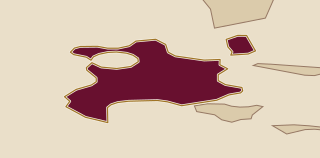
Mountains stand west of the property and Peninsula Dam lies to the east, with the Palmiet River running below the vineyards. The river begins in the surrounding ranges, and cold air drains down towards the vines at night, sometimes bringing mist. In this setting, grapes ripen over a longer period: Sauvignon Blanc can hold citrus-led acidity, Semillon can develop fuller fruit without losing lift, and the reds can arrive with moderate alcohol alongside ripe flavour.
Elgin is not merely the regional name on a label here. It is the cool valley condition behind the difference between the estate’s stainless-steel-fermented Sauvignon Blanc component and its barrel-matured Semillon, as well as the red-fruit and savoury profile reported for Rockview Ridge Pinot Noir.
In the cellar
Vineyards and cellar
The current farm describes sustainable winemaking practices and long-term conservation commitments, with habitat protected for other species alongside the 10 hectares of vines. In the vineyard, site and clonal detail matter because the winery has material with different acidity, perfume, colour and tannin to work with at harvest.
The premium wines have documented natural-yeast fermentations and low-sulfur handling, while cellar treatment changes by wine rather than following one formula. Triangle Block Semillon 2019 was chilled, sorted, destemmed and moved by gravity; selected parcels had skin contact before gentle pressing, then spent 11 months in French oak. The combination builds body and texture around Semillon’s stone-fruit character, with oak used as a frame rather than a blanket.
Wines to know
The range in view
Sanctuary Peak Sauvignon Blanc is the estate’s white blend built around Elgin Sauvignon Blanc, with Semillon added for width on the palate. Its split fermentation joins fresh, stainless-steel Sauvignon Blanc fruit to a small oak-fermented Semillon portion, so acidity remains active without leaving the wine narrow.
Capall Bán takes Sauvignon Blanc from selected top-performing vineyards and adds Semillon. The 2018 blend was 91.5% Sauvignon Blanc and 7% Semillon, at 13% alcohol with 6.1 g/l acidity and 3.2 g/l residual sugar. Fruit left longer on the vine brings a riper flavour profile and fuller mouthfeel, while the measured acidity keeps the finish dry in feel rather than heavy.
A useful way in
A bottle to begin with
Start with Triangle Block Semillon. It is 100% Semillon from selected parcels, naturally fermented and matured for 11 months in French oak, including larger-format wood and 30% new oak in the documented 2019 release. Expect stone fruit, subtle spice and a round, lees-shaped texture, then lively acidity and a long, gravelly finish. It puts Shannon’s cool Elgin ripening, parcel handling and measured barrel work in one glass.