
Why it matters
The producer
The farm supplies apples, sugar beets and malting barley, while ingredients it cannot provide are bought locally. That division matters in the bottles: apples lead the house’s apple spirits, while grain and locally sourced components support a broader distillery range. Its first commercially launched product was apple brandy, distilled in France from Swedish ingredients, placing fruit at the centre from the beginning.
The project began experimentally in 2006, when Kim Paulin and Jan Rothman distilled apples and matured the spirit on the farm. The company was formally established in 2011, after that first trial had set an apple-led direction. Its first officially launched product then carried the same fruit into a wider production chain: Swedish ingredients were distilled in France for an apple brandy. In 2024, the producer announced that it had been named Beverage Producer of the Year.
Place and vineyards
Where the wines begin
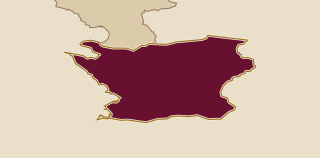
Södra Sandby is the producer’s documented home in Skåne, outside Lund. There is no supported vineyard, grape or appellation story here; the useful connection between place and bottle is the farm itself, where crops are grown before distillation and maturation turn them into spirits. Skåne appears through apples, barley and sugar beets rather than through a named wine district.
No soil profile, slope or parcel details are documented, so this is not a site story in the usual vineyard sense. The physical site is a working farm with apple trees, malting barley and sugar beets. Those crops make the farm a source of raw material for the distillery, while the absence of documented vineyard data keeps the focus on fruit, grain and production rather than invented terroir claims.
In the cellar
Vineyards and cellar
There are no documented vineyards or cellar parcels, but the distillery has a clear material flow. Farm-grown apples, sugar beets and malting barley enter production; ingredients unavailable from the farm are purchased locally. Spent mash and cooling water are reused in full, so production byproducts return to the farm system rather than ending at the still. For the London Dry Gin, the stated method is single distillation, a direct process that keeps the gin’s production distinct from the long-matured apple spirits.
Wines to know
The range in view
Despite the name of the category, this is a spirits-and-glögg range rather than a wine portfolio. Apple-based spirits form its core, and Äppelglöd is the mature expression: it spends more than five years ageing and is described with ripe-apple and vanilla notes. Äppelbox takes the apple range in another direction, gathering four different 100 ml apple-based spirits in a wooden presentation box for side-by-side comparison.
London Dry Gin provides the dry botanical branch of the range and is made through a single distillation. The seasonal glögg bottles add a different register: Skånsk vinterskog and Irish Coffee glögg are both listed through Systembolaget, while the latter also has an ingredient declaration supplied by XO Sweden Wines & Spirits AB. The range therefore moves from apple fruit and ageing to gin distillation and winter spicing, rather than presenting variations on one base spirit.
A useful way in
A bottle to begin with
Start with Äppelglöd. It is an apple-based spirit matured for more than five years, and its ripe-apple and vanilla notes join the producer’s farm-grown fruit to its longer ageing work. The bottle is more focused than the four-spirit Äppelbox and less botanical than the London Dry Gin, so it puts the original apple thread in the glass with the fewest distractions.