
Why it matters
The producer
The Snowden family arrived in 1955, inheriting a ranch whose grape-growing history reaches back to 1878. The family began keeping part of its harvest for estate-specific Snowden wines in 1993, changing the role of the vineyard from a source of grapes into the source of labelled Cabernet Sauvignon. Diana Snowden Seysses is the winemaker, while Severiano De Loera manages the ranch.
Wine grapes were first planted here by the Davises in 1878. By 1880, 75 acres had been cleared for vineyards and orchards. When Wayne and Virginia Snowden bought the property in 1955, only 13 acres remained actively cultivated; decades later, the family’s 1993 decision to retain fruit for its own wines put the Snowden name on bottles from the ranch rather than only on grapes sold onward.
Place and vineyards
Where the wines begin
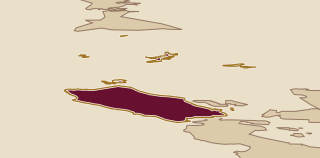
The ranch lies east of Rutherford and St. Helena, south of Howell Mountain and north of Pritchard Hill, on the eastern side of Napa Valley. That position places Snowden’s Cabernet Sauvignon in a hillside-and-valley setting rather than on the broad valley floor: the labels point back to a defined ranch, its slopes and its smaller pockets of vine land.
Snowden’s documented site facts are physical rather than geological: hidden valleys, gentler Vaca Mountains hillsides, 23 farmed acres and 137 acres of woodland. The woods keep the vineyard area visually and agriculturally contained, while the separate valleys and hillsides give the estate a reason to distinguish named Cabernet Sauvignon bottlings instead of presenting the ranch as one uniform block.
In the cellar
Vineyards and cellar
Snowden farms its vines with organic practices and pursues minimal intervention in the cellar. On a ranch with only 23 acres under cultivation, those choices keep the focus on estate fruit and on the differences between named vineyard selections. The approach does not promise a fixed flavour, but it makes the vineyard’s Cabernet Sauvignon the central material in the finished wines rather than covering it with a heavily prescribed cellar style.
Wines to know
The range in view
The range is anchored by estate Cabernet Sauvignon in two clearly different roles. Brothers Vineyard is a single-vineyard Cabernet Sauvignon, making vineyard origin part of the bottle’s structure as well as its name. Dum Spiro Spero is also Cabernet Sauvignon, but its 2020 release carries a distinct vintage story: fruit otherwise intended for Brothers and Los Ricos was brought together in one wine.
That architecture matters in the glass. A single-vineyard Cabernet directs attention toward one named source of fruit and its tannin, body and finish; Dum Spiro Spero records a one-vintage blend of fruit that would normally have appeared under separate labels. Neither role needs to be ranked for the difference to be useful: one isolates a vineyard, while the other preserves a harvest through one Cabernet bottling.
A useful way in
A bottle to begin with
Start with the 2020 Cabernet Sauvignon Dum Spiro Spero. It is a dry Cabernet Sauvignon made from fruit consolidated after the 2020 fires, when grapes normally intended for Brothers and Los Ricos were brought into this one Snowden-label red. Its value as a first bottle is concrete: it introduces the ranch’s Cabernet Sauvignon while carrying an event specific to one difficult vintage, rather than asking the label to stand for the whole range.