
Why it matters
The producer
On 29 February 1964, thirty-five winegrowers met in the municipal building of Orsogna, a hill town in Chieti province, and constituted a cooperative. Tommaso Simeoni became its first president. Six decades later, that same body, now trading as BIO Cantina Sociale Orsogna, represents approximately 300 active members farming 1,500 hectares of vines across central Abruzzo, and every hectare carries organic certification.
What changed most decisively was a decision taken in 1995, when the cooperative began converting its entire vineyard base to organic farming. No individual grower made that shift alone; the members voted it in collectively, which meant the certification program had to hold across hundreds of separate farming operations simultaneously. The Demeter biodynamic tier, which now covers half the vineyard area, came later and added a further constraint: spontaneous fermentation only, sulfite additions within the Demeter ceiling, tartaric stabilization by natural winter cold rather than refrigeration. These are choices that narrow a cellar's options considerably, and the cooperative made them at volume.
Place and vineyards
Where the wines begin
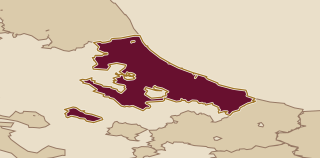
Orsogna sits in the province of Chieti in central Abruzzo, roughly twenty kilometres inland from the Adriatic coast. The vineyards occupy the corridor between two dominant geographic features: the Maiella massif to the southwest and the Adriatic Sea to the northeast. That position is not incidental to the wines. The Maiella, rising above 2,700 metres, screens the vineyards from cold inland air pushing in from the Apennine interior in late autumn, extending the growing season and reducing the risk of abrupt cold damage during ripening. The Adriatic provides the other side of the equation: sea breezes move through the vineyard rows through summer, lowering humidity and reducing fungal disease pressure. In a certified-organic vineyard, where synthetic fungicides are absent, that natural air movement is a practical advantage.
In the cellar
Vineyards and cellar
Organic farming across 1,500 member hectares means no synthetic herbicides, fungicides, or fertilizers at any site. The Demeter biodynamic tier goes further: biodynamic preparations applied to soil and plant, farming decisions oriented around a biodynamic calendar, and a winemaking protocol that excludes most of the interventions conventional cellars treat as routine.
In the cellar, Demeter biodynamic wines undergo spontaneous fermentation. Indigenous yeasts, present naturally on the grape skins at harvest, drive the conversion of sugar to alcohol without any commercial yeast addition. The practical consequence is that fermentation is less predictable and the aromatic profile of the finished wine reflects the microbiological character of the harvest year rather than a laboratory-selected strain. Tartaric stabilization, the process that prevents tartrate crystals from forming in the bottle, is achieved by exposing the wine to natural winter cold rather than mechanical refrigeration or chemical additives. The Demeter standard specifically permits this method and excludes the others.
Wines to know
The range in view
The Lunaria range carries the cooperative's Demeter biodynamic wines across four bottles, each built around a single grape or grape combination.
Lunaria Civitas is Pecorino, a native Abruzzese white grape. Pecorino produces aromatic whites with notable body for an Italian white, herbal lift on the nose, stone-fruit character in the mouth, and firm acidity that keeps the wine from feeling heavy despite its weight. Civitas was one of the two inaugural Lunaria bottlings and remains the clearest expression of the cooperative's commitment to Abruzzese native varieties.
A useful way in
A bottle to begin with
Start with Lunaria Charisma, the cooperative's Trebbiano d'Abruzzo. Choose it because it sits at the centre of what separates BIO Cantina Sociale Orsogna from a conventional cooperative: biodynamic farming, spontaneous fermentation from indigenous yeasts, lees contact in concrete, natural cold stabilization. No commercial yeast, no refrigeration, no oak. The wine is pale straw with a greenish edge, quiet on the nose, and then unexpectedly full in the mouth: body from the grape, texture from the lees, a savory finish that lingers. It is not a wine that announces itself. Drink it alongside a plate of food and it will hold its own longer than expected.