
Why it matters
The producer
Corvezzo farms 195 hectares on the alluvial plain of Treviso province and has held a full organic certification covering both vineyard and winery since 2017. The estate sits at Cessalto, a flat agricultural commune in northeastern Veneto, in the broad lowland between the Piave river and the Venetian lagoon. The family began farming here in 1955. Three generations later, the same ground produces Glera for Prosecco, Pinot Grigio, and a range of still wines sold across seven Italian regions under an organic and vegan flag.
Giovanni Corvezzo, the third generation, took control in 2009 and turned a farm already moving away from conventional agriculture into a fully certified organic operation. The change was neither quick nor symbolic. The transition ran seven years, from 2010 to 2017, and included replacing every animal-derived product in the winery with plant or mineral alternatives, fining wines with bentonite clay rather than egg white or isinglass, and earning a separate vegan certification alongside the organic one. Corvezzo is one of the few large Italian wine estates to hold both.
Place and vineyards
Where the wines begin
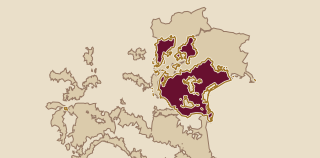
Cessalto lies in the low, flat territory of Treviso province, between the Piave river to the east and the Venetian lagoon to the south. The land here was drained and cultivated over centuries, and the soils are deep alluvial, well-drained, and highly productive. This is not the steep Cartizze hillside or the chalky ridges of Conegliano. The terrain allows the kind of scale Corvezzo has built: 195 contiguous or nearby hectares is feasible on the plain in a way it is not on the terraced slopes of the Prosecco Superiore DOCG zone.
In the cellar
Vineyards and cellar
Corvezzo manages 195 hectares of vineyards in Veneto, farmed without synthetic herbicides, pesticides, or fungicides. Canopy management takes on greater importance under organic rules in a humid lowland environment: vine spacing, leaf removal, and shoot positioning all affect airflow and disease resistance in ways that chemicals once handled. The estate does not claim all fruit is estate-grown; the sourcing includes both family vineyards and grower fruit.
In the winery, the organic certification extends to every input. Animal-derived products, including egg white and isinglass, have been removed from the fining process. Bentonite clay, a naturally occurring mineral, is used throughout. The vegan certification follows directly from this decision. Energy for the winery comes from the photovoltaic installation, and pruning wood that would otherwise go to waste feeds the biomass plant.
Wines to know
The range in view
The range includes Glera sparkling wines and Pinot Grigio, sold across seven Italian regions under organic and vegan certification. The flagship line centres on Glera in sparkling form and Pinot Grigio as a still white. Crudo Organic Sparkling Wine, made entirely from Glera, anchors the range. Pinot Grigio appears under organic certification and is described as one of the estate's two leading varieties.
Crudo is a Prosecco DOC wine made entirely from Glera.
A useful way in
A bottle to begin with
Crudo Organic Sparkling Wine is the right first bottle. It is 100% Glera, fermented and made sparkling in sealed tanks under Prosecco DOC rules, and it carries the entire Corvezzo argument in one glass: organic farming, light alluvial fruit, clean mousse, and a finish that invites the next sip rather than demanding attention. Green apple, fresh pear, citrus. No oak, no sugar weight, no age requirement. Open it cold, drink it young, and it does exactly what it promises.