
Why it matters
The producer
Franca Loia and her husband Patrizio started the estate in 2004 on seven hectares of land immediately surrounding their home in Empoli, a town in the western Arno valley roughly halfway between Florence and the Tyrrhenian coast. They did not come to wine through inheritance or appellation prestige. They came to it through the ground they already occupied.
The estate takes its name from their daughter Francesca, born after the founding purchase. Twenty-five hectares now cover two communes: three in Empoli and twenty-two in San Miniato, the medieval hilltop town southeast along the Arno. The whole holding is farmed organically, a choice the family describes as the method most suited to combining tradition with what they are trying to build. The labelled wines are Chianti DOCG reds and a Vermentino white, and both have reached export markets, including listing at Systembolaget in Sweden.
Place and vineyards
Where the wines begin
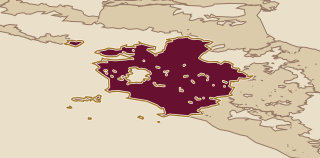
Empoli sits where the Arno bends west before Pisa, at the edge of the broad valley floor. The vineyards are not on the valley floor itself but on the hills above it, at around 120 metres above sea level, looking out across the river plain. This is Chianti DOCG territory, the wider appellation that rings Chianti Classico without sharing its central Gallo Nero zone. Wines labelled Chianti DOCG here are Sangiovese-led reds that may incorporate other permitted varieties but sit outside the stricter production rules of the Classico heartland.
Vermentino is unusual in this part of Tuscany. The variety is more typical of the Ligurian coast and Sardinia, and its presence here points to a deliberate choice to plant outside local convention.
In the cellar
Vineyards and cellar
The 25 hectares are split between Empoli and San Miniato, all on hillside ground overlooking the Arno valley. Vine density at 5,000 plants per hectare is moderate by modern Tuscan standards, encouraging individual vine development without the extreme stress of high-density planting.
The two training systems reflect parcel-by-parcel decisions rather than a single regime. Spur-pruned cordon keeps bud counts controlled and works well on vigorous clay soils; Guyot allows more flexible selection of cane wood and tends to be preferred for Sangiovese in wetter or more vigorous sites. The combination across 25 hectares suggests site-adapted management rather than blanket uniformity.
Wines to know
The range in view
Two wines are confirmed at retail. Lo Zio Chianti Riserva is a red wine produced under the Chianti DOCG appellation, composed of four grape varieties including Sangiovese as the primary. Chianti Riserva wines must spend a minimum of 24 months ageing before release under the DOCG rules, at least six of those in bottle. The Riserva designation indicates a longer-aged expression within the Chianti category. The specific four varieties used in Lo Zio are not confirmed beyond the DOCG's Sangiovese base requirement.
Poggio de Cansano Vermentino is 100 percent Vermentino, produced to organic certification. Vermentino in this part of Tuscany is a non-traditional choice. On clay-silt soils at moderate altitude, the variety typically produces white wines with fuller body than the leaner versions from coastal Sardinia, and the alkaline mineral base tends to give a slightly chalky grip rather than the saline edge of maritime sites.
A useful way in
A bottle to begin with
Start with Poggio de Cansano Vermentino. It is 100 percent Vermentino, organically grown, and it makes the clearest single argument for what the estate is doing: a family decision to plant an unusual white variety on clay-silt Tuscan hillsides and bottle it as a varietal wine. The grape is aromatic without being perfumed, tends toward stone fruit and herb on clay ground, and carries enough acidity on alkaline soils to stay lively without becoming sharp. A glass of it lands somewhere between the fuller coastal whites of Sardinia and the leaner whites of the Ligurian hills, shaped by its specific Arno valley address.