
Why it matters
The producer
Leonardo Bussoletti founded his estate in 2008 in the province of Terni, in the south of Umbria, and he runs it alone as owner, managing director and winemaker. The founding act was a grape, not a place: Ciliegiolo, a red variety that had largely disappeared from Umbrian viticulture by the time Bussoletti began working. He spent more than twenty-five years in wine before the estate existed, and when he finally planted his own flag, he planted it in a grape everyone else had mostly stopped growing.
The label designation is IGT Narni, a place-name classification without the classified hierarchy of a DOC or DOCG. That relative obscurity suits the project. Bussoletti works with Ciliegiolo, Grechetto and Trebbiano Spoletino under the IGT Narni designation.
Place and vineyards
Where the wines begin
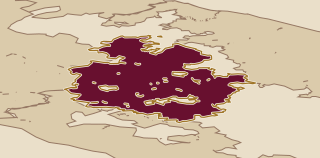
Narni and San Gemini are small hilltop communes in Terni province, set inland in the lower third of Umbria. The landscape here is quieter and less travelled than the Orvieto zone to the west or the Spoleto valley to the northeast. The nine hectares spread across four communes: Narni, San Gemini, Penna in Teverina and Attigliano. Parcels sit at around 290 metres for the Ciliegiolo and Grechetto plots, with an estate average near 300 metres.
The IGT Narni designation attaches the wine to the Narni area by name but carries no appellation hierarchy below it. There are no premier or grand cru vineyards to parse, no classified range within the designation. What the label offers is a place and a grape, which is Bussoletti's preferred frame of reference.
In the cellar
Vineyards and cellar
All nine hectares are farmed organically, certified by Suolo e Salute, with only natural treatments applied in the vineyard. Bussoletti works without commercial or synthetic pesticides.
In the cellar, fermentations are spontaneous: no added yeast of any kind. Instead, Bussoletti uses a pied de cuve built exclusively from native grapes, a small portion of the harvest fermented ahead of the main batch to generate active native yeasts that then drive the primary fermentation. The commitment to native-only yeast is specific and deliberate; it keeps the fermentation character within the parameters of what the vineyard itself produces.
Wines to know
The range in view
The range has three wines, each with a distinct grape logic.
Asla is the single-variety Ciliegiolo red, the wine that carries the founding argument of the estate. On the nose it offers cherry, blackberry, almond and violet. On the palate the tannins are firm but well-resolved, the acidity is genuine, and the fruit stays clearly defined. It is the most direct expression of what Bussoletti set out to make: Ciliegiolo grown and vinified without complication, under an IGT label.
A useful way in
A bottle to begin with
Start with Asla. It is a single-variety Ciliegiolo red from organically farmed, clay-limestone parcels at around 290 metres, fermented with no commercial yeast, only a native pied de cuve. No blending, no barrel ageing, no complexity imported from outside the grape and the ground. Cherry, blackberry, almond and violet in the glass; firm, fine tannins; genuine acidity carrying the wine forward without sharpness. It is the grape Bussoletti built his estate around, as plainly expressed as the range allows, and it answers the question the label asks: what does Ciliegiolo taste like when someone takes it seriously in southern Umbria.