
Why it matters
The producer
Podere Le Ripi makes Brunello di Montalcino, Rosso di Montalcino and Sant'Antimo in the Montalcino appellation. Amore e Magia is the estate's red Brunello di Montalcino wine, and Sebastian Nasello leads the estate as winemaker and director. He is also a partner in the venture.
The property covers over 53 hectares, divided among forest, vineyards, olive groves, gardens, orchards and pasture. Six hectares are gardens, and the farm also has an apiary, sheep, goats, ducks and geese.
Place and vineyards
Where the wines begin
Vines at opposite ends of an appellation do not ripen under the same conditions. Podere Le Ripi farms in Castelnuovo dell'Abate in the southeast of the Montalcino appellation and in Camigliano in its far west. The estate farms both positions before the grapes reach the cellar.
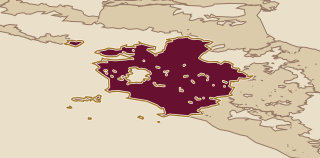
Castelnuovo dell'Abate has soils particularly rich in clay and silt, with oceanic origins dating to a time when Montalcino was a literal island surrounded by sea. Camigliano has alluvial clay and sand and a strong influence from the nearby Ombrone River.
In the cellar
Vineyards and cellar
The Bonsai vineyard is planted at 62,500 vines per hectare, with vines 40 centimetres apart. At that density, an unusually high number of individual vines occupy one hectare, and close spacing changes how the vines share water and light.
Fermentations are spontaneous, usually in cone shaped Vosges oak vats, and may last months or years. Spontaneous fermentation relies on naturally present yeasts, so the pace can vary. A very long fermentation can deepen colour and bring more texture through longer contact with the grapes.
Wines to know
The range in view
The range covers Brunello di Montalcino, Rosso di Montalcino and Sant'Antimo. Sant'Antimo carries a separate appellation name on the label, while Brunello di Montalcino and Rosso di Montalcino carry the Montalcino names. The Rosso and Brunello are energetic red wines.
Rosso and Brunello carry pure ripe fruit. Purity keeps the fruit clear, while ripeness brings fullness. Clay rich ground can support slower ripening and a broader palate, while the cooler western site can make acidity more apparent.