
Why it matters
The producer
Querciabella began as an entrepreneur's instinct. In 1974 Giuseppe Castiglioni, known as Pepito, acquired a small property at Ruffoli, a hillside hamlet sitting above Greve in Chianti. He was an industrial entrepreneur who collected wine seriously; the name he gave the estate, Querciabella, translates as "beautiful oak."
The founding purchase turned argumentative quickly. Through the 1980s and into the mid-1990s, Castiglioni planted French varieties on Chianti Classico hillsides and created two Super Tuscans: Camartina, a red built on those French grapes, and Batàr, a white. He acquired further vineyards and built a new cellar. By the time his son Sebastiano Cossia Castiglioni took over in the mid-1990s, the estate had already moved well outside the Sangiovese mainstream.
Place and vineyards
Where the wines begin
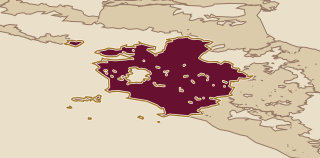
Chianti Classico is the historic heartland of Sangiovese between Florence and Siena, a DOCG appellation covering roughly 70,000 hectares of central Tuscany. Within that zone, Querciabella farms more than 50 hectares across three villages: Ruffoli, the original site above Greve in Chianti, plus later acquisitions in Radda in Chianti and Lamole. Each sits at moderate to high elevation for the zone, which slows ripening and gives the Sangiovese longer to build acidity and colour before harvest.
Ruffoli remains the primary site. Greve in Chianti lies in the northern part of the Chianti Classico zone, where galestro, a crumbly calcium-rich schist, and alberese, a harder clay-limestone, alternate across the slopes. Both soils drain well and push vine roots deep, contributing to the firm acidity and aromatic lift that characterise Sangiovese from this part of the appellation.
In the cellar
Vineyards and cellar
Querciabella farms more than 50 hectares across Ruffoli, Radda and Lamole under vegan biodynamic management. No synthetic pesticides, herbicides or fertilisers are used. Cover crops between vine rows build soil biology; treatments rely on copper and sulfur within organic limits. Biodynamic timing governs both vineyard work and, to the extent cellar schedules allow, bottling.
Wines to know
The range in view
The Querciabella Chianti Classico DOCG is the estate's Sangiovese blend. Built from that assembly of roughly sixty parcel lots, it covers the range of sites in Ruffoli, Radda and Lamole. Red cherry, plum and blood orange lead the nose, with cedar and rose petal underneath. The tannins are fine-grained; the acidity stays lively from palate through finish.
Camartina is the founding-era red: a Super Tuscan assembled from Cabernet Sauvignon and Merlot, the French varieties Giuseppe planted in the 1980s. It sits outside the Chianti Classico appellation and carries more weight, darker fruit and longer ageing potential than the estate label. The 2000 vintage received a Best Italian Wine award in 2004, after the estate had already reoriented toward Sangiovese.
A useful way in
A bottle to begin with
Querciabella Chianti Classico DOCG is the one to start with. It is 100 percent Sangiovese, assembled from sixty or so individual parcel vinifications across Ruffoli, Radda and Lamole, and matured for roughly 24 months before release. The nose is aromatic, with red cherry, blood orange, rose petal and a faint cedar note from the French oak. The palate is medium-bodied and supple, with bright acidity and tannins fine enough to drink now but substantial enough to develop. No single vineyard dominates; the wine is a portrait of what the estate does across all its Chianti Classico sites, farmed under biodynamic management and assembled with care rather than corrected in the cellar.