
Why it matters
The producer
Ripa della Volta was founded in 2015 by Andrea Pernigo, a Veronese entrepreneur who set out to make wines that speak for a specific valley: Valpantena. The estate owns and farms all 15 hectares of its vineyards directly, grows only native varieties, and holds organic certification across the entire holding. Around 60,000 bottles leave the cellar each year, a deliberately limited output for an estate with a stated commitment to hand-harvesting and parcel-level attention.
The Ripasso is the wine the estate built its reputation on, a Corvina-led blend refermented over Amarone pomace and aged in large Slavonian oak and French barrique. It remains the anchor of the range and the wine most widely found in export markets. In 2025, a decade after the founding, the estate released two new labels simultaneously: a Valpolicella Superiore from the 2023 harvest and a Soave Classico from 100% Garganega, moving into a white-wine appellation for the first time. Forbes Italia named the winery among Italy's emerging producers in the same year.
Place and vineyards
Where the wines begin
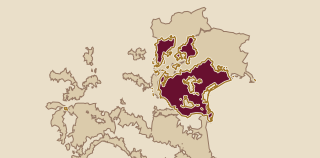
Valpantena is a sub-valley of the wider Valpolicella zone, running roughly north from Verona toward the Lessini Mountains. It sits a few kilometres from the city and carries its own distinct character within the Valpolicella DOC framework. On the label, wines from here may carry the Valpolicella designation with or without the Valpantena sub-zone name depending on the classification.
The valley's microclimate is Mediterranean in character, moderated by breezes descending from the Lessini Mountains above. At the elevations where Ripa della Volta farms, between 350 and 550 metres, these conditions translate into a longer, cooler ripening period than the lower Valpolicella floor delivers. For the Ripasso, that difference matters. A wine refermented over Amarone pomace and aged two years in oak might easily turn heavy or sweet; altitude-grown Corvina carries enough natural acidity and freshness to hold its line through the pomace contact and the oak ageing.
In the cellar
Vineyards and cellar
All 15 hectares are farmed organically and planted to six native varieties: Corvina, Corvinone, Rondinella, Oseleta, Spigamonte and Turchetta. Spigamonte and Turchetta are minor indigenous varieties rarely seen in commercial blends; their presence indicates a commitment to planting the valley's full native palette rather than only the commercially standard trio of Corvina, Corvinone and Rondinella. Grapes are harvested and selected by hand.
In the cellar, the Ripasso is made in two stages. The first fermentation splits between temperature-controlled stainless steel and wood. The wine is then passed over Amarone pomace, the partially dried skins and seeds left from Amarone production, and undergoes a second fermentation lasting approximately ten days. This is the ripasso method: it adds body, colour and dried-fruit depth without the full drying process used for Amarone. After the pomace contact, the wine ages for approximately two years in 25-hectolitre Slavonian-oak casks and French-oak barriques, giving further grip and integration without masking the freshness from altitude.
Wines to know
The range in view
The range as of 2025 has three anchors.
The Valpolicella Ripasso DOC is the estate's flagship and the wine that defines the house character. The blend is vintage-dependent: the 2021 used 70% Corvina and 20% Corvinone, with Rondinella, Oseleta and Turchetta completing the blend. The wine ferments partly in steel and partly in wood before ten days on Amarone pomace, then ages two years in large Slavonian-oak casks and French barrique. It reads dry, with red fruit, lifted floral notes from altitude-grown Corvina, and firm tannin from the pomace contact and oak time. Acidity is the defining thread: it runs from the first pour through to a clean, dry finish.
A useful way in
A bottle to begin with
Start with the Valpolicella Ripasso DOC. It is the wine the estate was designed to make and the one that demonstrates the Valpantena character most directly: Corvina-dominant, grown at altitude on limestone-rich marl, refermented on Amarone pomace for ten days and aged two years in large oak. The combination should produce a heavy wine. It does not. The altitude and the limestone keep the acidity alive, the organic farming keeps the fruit clear, and the Ripasso tastes like a red wine that happened to spend time on pomace rather than a pomace wine that happens to be red.