
Why it matters
The producer
The Scala family has farmed land around Cirò Marina for roughly two hundred years. Wine production under the family name started in 1949, and the winery building came much later, completed in 2005. Luigi Scala now runs the estate with his son Francesco, who joined in 2008 to handle the business side. The property covers 18 hectares planted with Gaglioppo, Greco Bianco, Magliocco, Nerello Mascalese, Mantonico and Greco Nero. Every bottle comes from that estate fruit. Published trade and educational sources report between 60,000 and 100,000 bottles annually, the spread reflecting different counting windows rather than any change in the vineyards.
Gaglioppo is the red grape here, giving the Cirò Rosso its tannin, dark fruit and capacity for extended ageing in concrete. Greco Bianco produces the white. The other native varieties fill supporting roles across the range.
Place and vineyards
Where the wines begin
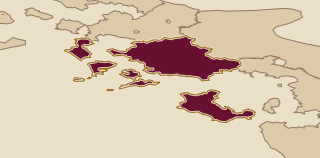
Cirò Marina sits on the Ionian coast of Calabria, the long toe of the Italian peninsula. The Ionian here is warm and bright, and the town is low-lying, the vineyards spreading across both coastal plains and inland hills behind the settlement. This corner of Calabria is one of Italy's oldest wine-producing zones, with Gaglioppo so rooted in the landscape that Cirò DOC is built almost entirely around it for red and rosato wine, and around Greco Bianco for the white. The appellation name on the label signals which grape dominates the bottle.
Calabria's south-facing exposure and long dry summers push Gaglioppo toward full ripeness each year. The challenge is not accumulating sugar but preserving the fresh, savory character the grape can carry when the harvest timing is right.
In the cellar
Vineyards and cellar
All 18 hectares are estate-owned and farmed organically. The cover crop rotation includes lupins, which return nitrogen to the soil and suppress weeds between the vine rows, replacing the synthetic fertilizers and herbicides that organic conversion removed.
In the cellar, Gaglioppo for the Cirò Rosso Classico Superiore ferments and then matures in concrete tanks for approximately eighteen months before bottling. Concrete is non-porous and temperature-stable; it preserves the grape's fruit character and tannin without adding oak flavor or oxygen-driven softening. The Cirò Rosato, also 100% Gaglioppo, spends six months in stainless steel. The Cirò Bianco, from 100% Greco Bianco, ferments in stainless steel over about ten days and stays in tank for six months, a choice that keeps the white fresh and preserves its fruit aromatics.
Wines to know
The range in view
The three-wine Cirò range is organized around colour and grape, with the red as the most substantial bottle. The Cirò Rosso Classico Superiore is pure Gaglioppo, its eighteen months in concrete giving the wine a firm tannic frame and allowing the dark fruit to develop without losing its savory edge. The Cirò Rosato is lighter and more immediate: same grape, shorter vessel time, and the stainless steel retaining the fresh strawberry and floral character that Gaglioppo can show in a pink wine. The Cirò Bianco, from Greco Bianco, is the narrowest of the three, built around delicate fruit, a hay-and-dried-flower aromatic thread, and a firmly saline palate.
The Cirò Rosso opens on preserved sour cherry, ripe serviceberry, violet, and a note of juniper and autumn forest floor. Gaglioppo gives the wine its tannin, and eighteen months in concrete allows those tannins to settle into an enveloping, balanced body. The finish is long, with a firm tannic grip supporting what the tasting notes describe as an enviable overall frame.
A useful way in
A bottle to begin with
Begin with the Cirò Rosso Classico Superiore. It is 100% Gaglioppo matured in concrete for eighteen months: a wine where the native grape and the vessel choice both show clearly. The nose gives sour cherry, ripe serviceberry and violet, then deepens into juniper and forest floor. The palate is full and balanced, with firm but polished tannin and a long finish. This is the bottle where the estate's farming, its concrete cellar choice, and Gaglioppo's character as a southern Italian red grape arrive together.