
Why it matters
The producer
Rino Sottimano completed his oenology studies in the late 1960s and started making wine from a single plot in the Barbaresco zone. That was the whole estate. Over the decades that followed, he and his wife Anna worked plot by plot through the Neive and Treiso hillsides, acquiring parcels in several of Barbaresco's named crus. Several of those early plantings, laid down in the 1970s and 1980s, are still in fruit.
Today the estate farms 19 hectares across five crus: Basarin, Cottà, Pajorè, Fausoni, and Currà. Rino's children Andrea, Elena, and Claudia now work the estate alongside him in both vineyard and cellar. All five vineyards are certified organic.
Place and vineyards
Where the wines begin
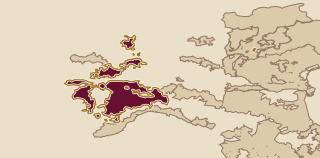
Barbaresco DOCG covers a cluster of hillside communes in the southern Langhe, south-east of Alba: the Barbaresco commune itself, plus Neive, Treiso, and San Rocco Seno d'Elvio. Nebbiolo is the only permitted grape. The wines must be aged at least two years before release, with at least nine months in wood, and single-vineyard or cru bottlings sit at the top of the hierarchy.
Sottimano's estate sits in the Cottà locality of Neive, and all five of its crus fall within Neive and Treiso. The two townships occupy the eastern side of the Barbaresco zone, where the Tanaro river defines the valley floor and the vineyards climb the slopes above. Neive and Treiso together produce a large share of the appellation's cru-labelled wines, and the cluster of crus here means that neighbouring parcels can share a hillside and still produce measurably different wine.
In the cellar
Vineyards and cellar
Organic certification covers all 19 hectares. In the vineyard, natural grass cover grows between the vine rows and is mowed two or three times annually; every other inter-row is tilled during autumn to manage soil compaction. No synthetic treatments are used.
In the cellar, fermentation takes place in oak vats with indigenous yeasts. The wine spends 20 to 22 months in oak cask before bottling. Every wine is bottled without fining or filtration, which means the wine in the bottle carries exactly what the fermentation and cask produced: nothing has been stripped or clarified. The same process applies to all five cru Barbarescos. This is deliberate. If every Barbaresco goes through the same oak vats, the same cask time, the same unfined bottling, then whatever differences appear in the finished wines have only one origin: the vineyard.
Wines to know
The range in view
Sottimano produces five single-cru Barbaresco DOCG wines, all from Nebbiolo:
Barbaresco Basarin is grown in Neive. Old-vine Nebbiolo from one of the estate's earliest-acquired parcels.
A useful way in
A bottle to begin with
Start with the Barbaresco Pajorè. It is a single-cru Nebbiolo from the Neive or Treiso hillside, aged in oak for 20 to 22 months, and bottled without fining or filtration. The 2021 vintage sits at 14.5 percent alcohol and is already open, with the fruit and acidity to develop further. The palate is concentrated: dark cherry, firm tannin, a long acid-driven finish that keeps the wine from feeling heavy. It is a direct expression of what Sottimano does without any intervening cellar adjustment.