
Why it matters
The producer
Dirk Würtz is managing director and winemaker, with Robert Borenstein as cellar master. St. Antony joined the VDP in 1990, has farmed under certified-organic standards since 2006 and gained Demeter certification from the 2018 vintage. Its Riesling work joins red-slate sites around Nierstein to bottles that can be broad and citrus-led or tied closely to a single vineyard.
The estate says its first vintage was 1918 and its official founding in Nierstein followed in 1920, under Gute Hoffnungshütte. Present family ownership began with the 2005 purchase and was followed by continued investment in Roten Hang parcels. The effect is visible in the bottle line: a large holding in Pettenthal, added Brudersberg land and other named sites give the cellar fruit for both blended Riesling and vineyard-specific releases.
Place and vineyards
Where the wines begin
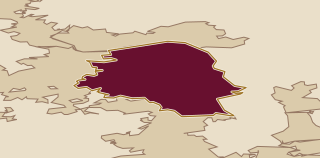
Nierstein’s Roten Hang is the estate’s central address: steep vineyard land beside the Rhine, where Riesling has the warmth to develop citrus and stone-fruit character while retaining acidity. St. Antony divides this fruit between its dry Rotschiefer bottling and Grosses Gewächs wines, so a label can signal whether the wine comes from several Roten Hang sites or a more narrowly defined vineyard source.
Red slate and calcareous marl are the two geological threads cited across the estate. Pettenthal, where St. Antony owns nearly 10 hectares, is marked by bare red slate; Zehnmorgen combines limestone and clay. Those physical differences sit behind a range built from more than one register of Riesling rather than one uniform house style.
In the cellar
Vineyards and cellar
Organic farming became certified in 2006, Demeter certification arrived with the 2018 vintage, and from 2019 St. Antony removed machine work from every steep-slope parcel. Hand work is particularly relevant where slope limits access: grapes can be handled parcel by parcel before they become part of Rotschiefer or a site wine.
The estate uses spontaneous fermentation and gentle handling in the cellar. For the 2021 Nierstein Blaufränkisch, fruit from Pettenthal and Ölberg was hand-picked, destemmed, fermented on the skins and aged for a year in wooden barrels. Skin contact supplies colour and tannin; the year in wood supports the wine’s darker fruit and tobacco notes without turning it into an oak-led red.
Wines to know
The range in view
Riesling provides the spine of the range. The 2023 Riesling Rotschiefer is dry, 100% Riesling from Pettenthal, Orbel, Hipping and Ölberg: a multi-site wine carrying a wider slice of the Roten Hang than the Grosses Gewächs wines. Its warm citrus, savoury spice and extract give it more weight than a simple light white while leaving acidity active on the palate.
Blaufränkisch takes two forms. The 2021 Nierstein Blaufränkisch is a red with cherry, blackberry and tobacco, shaped by skin fermentation, tannin and barrel ageing. The 2022 St. Antony Rosé combines Pinot Noir and Blaufränkisch; it is dry and medium-bodied, with 11.5% alcohol, red berries and white flowers, plus raspberry and cherry on the palate. Its 6.9 g/l acidity keeps the residual sugar of 8.7 g/l from reading as heavy.
A useful way in
A bottle to begin with
Start with the 2023 Riesling Rotschiefer. It is dry Riesling drawn from Pettenthal, Orbel, Hipping and Ölberg, so one bottle brings together red slate, cooler exposures and the estate’s broader Roten Hang holdings. Citrus and nectarine lead, then grapefruit, savoury spice, acidity and a firm extract-driven texture take the wine into a long finish. It shows how St. Antony turns several named sites into a single, coherent white.