
Why it matters
The producer
Strekov 1075 is Zsolt Sütó’s 12-hectare organic estate in Strekov, or Kürt, near Slovakia’s border with Hungary. Its name joins the place to the cellar door: 1075 is both the earliest written trace of the village and Sütó’s house number. That local frame carries into bottles made from Central European grapes, rather than an international-variety formula.
Sütó works varieties with local names and long regional roots: Rizling vlašský, Veltlínske zelené, Modrý Portugal, Frankovka modrá and Svätovavrinecké. The result is a range that moves from white wine to red and skin-contact wine, with grape character and handling doing the sorting rather than a single house style.
Place and vineyards
Where the wines begin
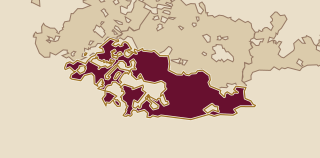
Strekov sits in southern Slovakia, close to Hungary, with marshlands and the Danube River nearby. The wetlands and river contribute to the vineyards’ microclimate, so the estate’s fruit grows in a landscape shaped by water as well as by the inland border. That setting is part of why the wines are best understood through their village and their regional grapes, not through a borrowed appellation shorthand.
The local name Kürt matters because it is another name for the same village printed into the estate’s story. On a Strekov 1075 label, place is not a distant regional badge: it is the village attached to Sütó’s home, vineyards and fermentation cellar.
In the cellar
Vineyards and cellar
Naturalis SK certification anchors the vineyard work, while manual work and local wooden stakes keep cultivation physically close to each vine. In the cellar, spontaneous fermentation lets the fruit begin on its own yeasts; open vats and old oak barrels of different sizes provide the vessels for fermentation and ageing. Old oak is useful here because it can hold and mature wine without automatically turning every bottle into a show of new wood flavour.
Skin contact plays a separate role in wines such as Porta. White grapes fermenting with their skins take on colour, tannin and a firmer texture, so the wine sits apart from a straightforward white. Across the range, no fining or filtration means the wine is not clarified by those processes before bottling; no added sulfur is the final part of that cellar approach.
Wines to know
The range in view
The range has several routes through Strekov’s grapes. Porta is the skin-contact branch: Welschriesling and Grüner Veltliner, called Veltlínske zelené locally, meet their skins to produce an orange wine with colour, grip and more tactile weight than a conventional white. Creme and Aurelius extend the named white-wine side, with Aurelius tied to its small east-facing 2008 planting.
Veltlín is the white in focus: Veltlín 2022 is Veltlínske zelené raised for six to eight months under flor in untopped 300-litre Zemplén oak barrels. Flor is a yeast layer that forms above the wine in a partly air-filled vessel; leaving the barrel untopped introduces an oxidative edge alongside fruit and acidity. The red wines bring Modrý Portugal, Frankovka modrá and Svätovavrinecké into view. Fred, a red in the range, has been noted for fruit, texture and a savoury turn as it opens.
A useful way in
A bottle to begin with
Choose Veltlín 2022 first. It is a dry Grüner Veltliner under its local name, Veltlínske zelené, and its six to eight months under flor in untopped 300-litre Zemplén oak barrels give the bottle a distinctive cellar shape. Citrus, pear and pepper arrive with oxidative savouriness; acidity keeps the palate moving, while the barrel ageing adds texture rather than a heavy oak flavour. It brings village grape, open-minded cellar work and a specific vintage into one glass.