
Why it matters
The producer
In Pedemonte di Valpolicella, a village at the heart of the Classica zone in the Veneto, Tedeschi is a family wine estate that traces its Valpolicella activity to 1630. The modern version of the winery was shaped in the 1960s by Lorenzo Tedeschi, who decided that Monte Olmi, a vineyard the family had held since 1918, was producing something the rest of the estate was not. He vinified its sun-exposed terraces separately, labelled the result under the vineyard name, and the first Amarone Capitel Monte Olmi appeared in 1964.
That decision established the working logic the estate still follows: named vineyards and hillside altitude, not appellation reputation, are how Tedeschi separates one wine from another. Three siblings now run the estate across clear roles. Antonietta has led Italian market strategy for more than thirty years. Sabrina covers international markets. Riccardo, the family enologist, manages the technical direction of the wines.
Place and vineyards
Where the wines begin
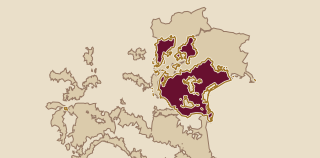
Valpolicella is a hilly zone immediately northwest of Verona. The Classica zone covers the original western hillside communes, including San Pietro in Cariano, where Monte Olmi sits, and Fumane, where La Fabriseria was planted in the early 2000s. The DOC extends the zone eastward into communes including Tregnago and Mezzane di Sotto, where the Maternigo property lies.
That east-west distinction matters on the label. Classica wines draw from the original, tighter hillside area; DOC wines, including those from Maternigo, come from a broader and geologically varied extension. Both categories are made from the same native varieties, Corvina, Corvinone, and Rondinella, but the altitude, soil mix, and exposition vary enough that the wines read differently. Tedeschi keeps the two zones separated at the vineyard and bottle level rather than blending across them.
In the cellar
Vineyards and cellar
All hillside terroir wines are produced exclusively from grapes grown on slopes, a distinction the family makes explicit. The four valley-floor hectares yield a lighter, early-drinking Valpolicella that sits outside the named-vineyard range.
Amarone is produced by drying the harvested grapes, a process called appassimento, typically for three to four months before fermentation. Drying concentrates sugar, colour, and flavour, and the resulting wine is dry despite the high potential alcohol, with deep, dark fruit, firm body, and tannin that requires time in the bottle. Capitel Monte Olmi is fermented from the terraced Monte Olmi grapes and aged before release as Amarone DOCG.
Wines to know
The range in view
The range is organised around three vineyard sources and five Amarone expressions.
Capitel Monte Olmi is the flagship Amarone, drawn from the terraced, south-facing upper section of Monte Olmi in Pedemonte. It is a Classica wine built on Corvina-led appassimento fruit: concentrated dark cherry, dried plum, and bitter chocolate, with firm tannin, high body, and the depth to develop over a decade or more. La Fabriseria is the second single-vineyard Classica Amarone, from the Le Pontare parcel between Sant'Ambrogio and Fumane; planted more recently, it brings a somewhat different hillside character than the older Monte Olmi terraces.
A useful way in
A bottle to begin with
Start with Maternigo Valpolicella Superiore. It is made from the three native varieties, Corvina at 40%, Corvinone at 30%, Rondinella at 30%, grown on the calcareous hillside parcels of the 84-hectare eastern property between Tregnago and Mezzane di Sotto. Aged to Superiore qualification, it is fuller than a table Valpolicella and carries the dried-plum lift of hillside farming without the weight and tannin demand of an Amarone. Black cherry, redcurrant, and plum come first, underpinned by mineral notes. The palate is round, with present acidity and fine tannins. The finish is long and tart. Decant it briefly and drink it with food.