
Why it matters
The producer
Tenuta Alzatura is the Cecchi family's Umbrian estate, founded in 1998 on 30 hectares of stony clay outside the hilltop town of Montefalco in the province of Perugia. The Cecchi family built its wine business in Tuscany and had never farmed beyond that region until Sagrantino drew them across the border. They built the estate around three separate named vineyard parcels within the Montefalco appellation: Monterone, San Marco, and Alzatura. Four wines come from those parcels, covering the appellation's two red classifications and two whites from the local Trebbiano Spoletino grape.
Sagrantino is the anchor. It is a thick-skinned, intensely coloured variety with one of the highest recorded polyphenol levels of any red grape, producing wines with substantial extraction and firm, grippy tannin. At Alzatura, the approach to the grape centres on finding enough freshness in the soil and farming to keep that weight in balance. Organic methods govern both vineyard and cellar work.
Place and vineyards
Where the wines begin
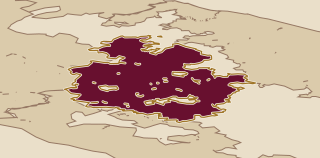
Montefalco is a walled hilltop town in central Umbria, roughly midway between Assisi and Spoleto. The Montefalco appellation covers red and white wines from the surrounding hills, but the name carries most weight on the label of its highest-classification red: Montefalco Sagrantino DOCG, a denomination reserved for wines made entirely from Sagrantino grown within the appellation boundary. Below it sits Montefalco Rosso DOC, a Sangiovese-led blend that includes a proportion of Sagrantino. The two white wines carry Montefalco DOC Bianco.
The hill position feeds cooler air into the vineyards, and that cooling effect matters for a grape that can otherwise tip from dark-fruited and firm into something extracted and dry. The clay and stone soils hold moisture through summer without waterlogging the roots, giving the vines consistent access to water that supports freshness rather than heat-stressed ripeness.
In the cellar
Vineyards and cellar
The three vineyard parcels, Monterone, San Marco, and Alzatura, all lie within the Montefalco appellation. The stony clay soils across the estate were the basis for the clone selection work carried out during establishment: matching Sagrantino rootstocks and clones to the specific texture and water-holding behaviour of clay with limestone pockets.
Cellar process for the red wines has not been confirmed in detail for current vintages. The Montefalco Rosso DOC requires at least 60 percent Sangiovese in the blend, with Sagrantino filling part of the remainder. Aria di Casa, the oak-aged white, received 10 months in barriques followed by bottle ageing in a documented 2019 programme. Whether that schedule applies to more recent vintages is not confirmed. Cortili, the other white, is aged in stainless steel.
Wines to know
The range in view
The four wines divide cleanly by grape and appellation tier.
Montefalco Sagrantino DOCG is the top red and the estate's most demanding bottle. One hundred percent Sagrantino, it carries the full weight of the variety: deep colour, firm tannin from the high polyphenol load, and substantial extraction that needs time to open. It is the appellation's highest classification and the reason the estate exists.
A useful way in
A bottle to begin with
Start with Aria di Casa. It is 100 percent Trebbiano Spoletino, a white variety native to the Spoleto valley that rarely appears on labels outside central Umbria, and it arrives from a producer built around Sagrantino. That combination, an unusual local white made with some care and oak ageing at a Sagrantino estate, is the most direct route into what Alzatura is actually doing beyond the obvious flagship. In the glass: wildflower aromatics, a toasted nut note from oak contact, and a fuller body than the grape's relative obscurity might suggest. It is not a heavyweight, but it has enough texture to take food.