
Why it matters
The producer
Davide Laiolo farms six hectares in Vinchio and makes exactly two wines. One is a Viognier white in a region better known for Barolo and Barbaresco. The other is a Nebbiolo rosé. Neither bottle is a detour from something more serious; both are the point.
The estate is registered as Tenuta Bricco San Giorgio di Laiolo Davide, based at Strada San Giorgio in Vinchio, a hillside commune set inside the Monferrato zone of Asti province. Davide manages every row of vine himself. The rows run perpendicular to the hillside in the traditional Monferrato pattern, the same layout his grandfather Gino farmed before him.
Place and vineyards
Where the wines begin
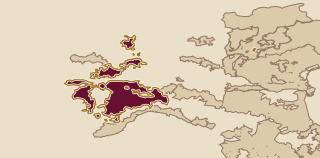
Vinchio is a small commune in the Monferrato hills, the broad rolling zone of Asti province that sits south and east of the Langhe, where Barolo and Barbaresco occupy the wine conversation. Monferrato produces wine under a looser set of appellations, the most geographically inclusive of which is Piemonte DOC, a regional designation that covers varietal whites and rosés that fall outside the tighter village-level rules of Barolo, Barbaresco, and Nizza.
Both Biancoluna and La Giorgina carry the Piemonte DOC label. Viognier and a Nebbiolo rosé fit there because neither wine matches the varietal or colour requirements of any of the named Monferrato sub-appellations. The DOC is broad, but the wine inside it is specific: two grapes chosen deliberately, on a hill selected for its soil and exposure, in six hectares managed by one person.
In the cellar
Vineyards and cellar
The six hectares in Vinchio are managed personally by Davide. Site selection was made on the basis of soil character and aspect. The rows run perpendicular to the slope in the traditional Monferrato pattern, a layout that keeps each vine face oriented for maximum light and allows water to drain cleanly down the hillside rather than pooling.
Green harvest is applied every year. The yield from each vine is limited to what that vine can ripen fully. Bunches left beyond that threshold are removed, concentrating the plant's energy into fewer, better-developed grapes.
Wines to know
The range in view
Two wines. Different grapes, different colours, and no structural overlap.
Biancoluna is made entirely from Viognier, the white grape native to the northern Rhône valley in France. Viognier is almost invisible in Piemonte, where white wine production is dominated by Moscato, Arneis, and Cortese. Biancoluna 2023 carries yellow-fleshed fruit on the nose, with acacia flowers and peach. The palate is medium-bodied, with balanced acidity that keeps the wine from reading as heavy or oily. Nuts and a faint walnut bitterness appear on the finish. The wine is dry.
A useful way in
A bottle to begin with
Start with La Giorgina. A Nebbiolo rosé from a six-hectare Monferrato estate is an unusual bottle. The wine is vinified from brief skin contact in the press and ten to twelve days of fermentation in stainless steel. La Giorgina is pale pink, with real but contained tannins, red fruit, dried flowers, strawberry at the centre of the palate, and a clean, slightly bitter finish. Nebbiolo always leaves a mark on the finish, and La Giorgina does too, even without the full tannin weight of a Barolo. The grape character is unmistakable.