
Why it matters
The producer
Tenuta Buon Tempo sits at Castelnuovo dell'Abate, a village at the southern tip of the Montalcino denomination where the land drops toward the Orcia valley and the climate runs warmer and drier than the north. Swedish entrepreneur Per purchased the property in 2012 and gave it a new name, a tribute to the Tuscan countryside around it. His wife Janet is an international wine trader; Per also produces wine at a château in France. The day-to-day operation belongs to Alberto Machetti, who grew up on the estate, trained as an enologist, and now leads the team while handling its commercial and accounting work. Winemaking consultants Attilio Pagli and Stefano Bartolomei support production decisions.
The cellar was configured from the start around large neutral vessels. Slavonian-oak casks and tonneaux became the main ageing containers for Brunello, chosen to let the Sangiovese fruit and site character develop without the vanilla and toast overlay of small new-oak barriques. More recently, the cellar has added amphora and cocciopesto alongside those casks, extending the range of textures the estate can produce.
Place and vineyards
Where the wines begin
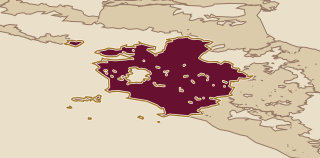
Castelnuovo dell'Abate lies at the southern foot of the hill of Montalcino, close to where the Sant'Antimo abbey stands in the valley. The position matters for the wine because this corner of the denomination receives more heat and less moisture than the cooler, higher-elevation zones to the north and east. Sangiovese Grosso at Castelnuovo dell'Abate ripens fully and consistently, producing wines with generous fruit and rounded weight alongside the grape's characteristic acidity and firm tannin.
Montalcino's denomination boundary defines what goes on the label. Brunello di Montalcino DOCG requires Sangiovese Grosso only, at least five years total ageing before release (six for Riserva), and a minimum of two years in oak. Rosso di Montalcino DOC draws from the same grape and denomination but is released earlier, giving a lighter, more immediate wine from the same geographic base. Where the vineyard sits within Montalcino shapes which bottles the fruit goes into and how they taste.
In the cellar
Vineyards and cellar
All fourteen hectares are planted with Sangiovese Grosso trained on the Cordon Spur system, which restricts yield per vine and concentrates fruit expression. Five hectares supply Brunello di Montalcino and its Riserva. The majority of the remaining nine supply Rosso di Montalcino, with a small portion going to La Furba IGT.
In the cellar, Brunello matures for three years in large Slavonian-oak casks before release. Slavonian oak has larger grain and thicker staves than French oak, which slows oxidation and contributes less aromatic character to the wine. Three years in those casks softens the Sangiovese tannin gradually and allows the wine to develop complexity without absorbing strong wood flavours. The Rosso spends less time in oak and reaches market earlier, preserving the grape's primary fruit and the site's firm acid line. Amphora and cocciopesto, an ancient Roman concrete-style material, introduce further variation: both vessels are oxygen-permeable but neutral in flavour, producing wines with slightly different texture than those matured in wood.
Wines to know
The range in view
The range has three levels. Rosso di Montalcino DOC is the entry wine: Sangiovese Grosso from the same certified-organic parcels as the Brunello, harvested and released earlier, with dried cherry, violet, and earthy iron on the nose, firm acidity running through the mid-palate, and chalky tannin on the finish. It has the grip and acid line of the appellation without the weight that comes from extended oak ageing.
Brunello di Montalcino DOCG receives three years in large Slavonian-oak casks after at least five years of total ageing before release. The fruit deepens from the Rosso's cherry register into darker plum and dried herb territory, the tannin tightens over time, and the acid framework remains the same structural backbone. The wine needs time and rewards it.
A useful way in
A bottle to begin with
Start with the Rosso di Montalcino. It is the same Sangiovese Grosso, from the same organically farmed parcels at Castelnuovo dell'Abate, released after a shorter ageing period and sold at a lower price than the Brunello. The fruit is dried cherry and violet, the acidity is firm and mouth-watering, and the chalky tannin gives the wine enough grip to work with food without demanding years in a cellar. The iron and earth notes underneath the fruit are the site speaking plainly, without the additional complexity that long oak ageing and extended time in bottle bring to the Brunello.