
Why it matters
The producer
Tenuta Carobbio sits inside the Conca d'Oro, a south-facing amphitheater of hills above the Greve valley that Panzano growers have long treated as the warmest and most reliable ripening ground in the Chianti Classico zone. The 16 hectares of vineyards face south and southeast, averaging 30 to 35 years of age, planted at high density so each vine carries few bunches and those bunches ripen fully. Dario Faccin, who joined as winemaker and estate manager in 2013, sets the tempo from bunch thinning in summer through manual harvest and prolonged maceration in the cellar. The Novarese family, which owns the estate, relaunched the range in 2013 after nearly three decades of quieter operation following Carlo Novarese's 1985 purchase of a property that had been a converted farmhouse.
The range holds two distinct arguments. One follows the Chianti Classico DOCG, with Sangiovese aged in Slavonian oak. The other runs through varietal IGT Toscana bottlings, where the same Sangiovese and a separate Cabernet Sauvignon receive French oak and longer ageing ambitions.
Place and vineyards
Where the wines begin
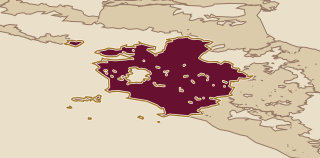
Chianti Classico is the historic core of Tuscany's wine country, occupying the hills between Florence to the north and Siena to the south. Panzano in Chianti sits near the southern end of that zone, in the Greve valley watershed. Within Panzano, the Conca d'Oro, whose name translates roughly as golden bowl, refers to the natural amphitheater formed by the surrounding hills. The bowl traps warmth, faces the sun through the long afternoon, and gives Sangiovese a longer effective growing season than exposed ridge sites nearby.
The Chianti Classico DOCG requires at least 80 percent Sangiovese, and at the Annata level the wine must age for at least one year before release. At the Riserva level, ageing extends to at least 24 months. Carobbio's vineyards in the Conca d'Oro translate directly into riper tannin from Sangiovese than cooler northern Chianti Classico sites typically give, with fruit that can support the prolonged maceration Faccin applies before the wine goes into wood.
In the cellar
Vineyards and cellar
High-density planting limits each vine to few bunches, concentrating the vine's energy into a smaller crop. Summer bunch thinning removes the least advanced clusters before they have a chance to drag the ripeness of the others. Both decisions push the same direction: fruit that is physiologically complete at harvest, with tannin that has lost its green grip. Harvest is entirely by hand, with selection at the picking stage rather than on a sorting table.
Wines to know
The range in view
The Chianti Classico Annata is at least 90 percent Sangiovese blended with small amounts of other authorised red varieties and aged in Slavonian oak. Tasting notes across the 2016 to 2018 vintages point to dried cherry, violet, iron-rich earth, and firm tannin from the extended maceration, with a persistent acid line that anchors medium-term ageing of five to eight years. The Riserva extends maceration and wood ageing, adding grip and depth without departing from the same Sangiovese and Panzano fruit character.
Leone is 100 percent Sangiovese aged in French oak, darker in fruit than the Annata, with more extraction and additional tannin grip from the barriques. It sits above the Riserva in the range hierarchy and shows what the same grape does when oak selection and longer ageing ambitions move it away from the appellation model.
A useful way in
A bottle to begin with
Start with the Chianti Classico Annata. It is the estate's most direct argument for what the Conca d'Oro produces: Sangiovese, prolonged maceration, Slavonian oak, and the south-facing hillside warmth that brings tannin to full ripeness without losing the acidity that supports ageing. The dried cherry and violet on the nose, the firm mid-palate tannin, and the mineral finish tell you what this vineyard and this cellar are doing without the French oak overlay of the varietal crus. It is also the point of entry for Chianti Classico more broadly: after one bottle here, the Riserva and Leone make immediate sense.