
Why it matters
The producer
Tenuta De Angelis farms organic vineyards in the Piceno hill country of southern Marche, splitting its land between two municipalities: Castel di Lama, where the winery sits at Via San Francesco 10, and Offida, a hilltown about fifteen kilometres south. Both place names appear on the labels. The Fausti family runs the estate; Alighiero Fausti is the current head, representing the generation that completed the conversion to fully certified organic farming. Three grapes organise the range: Passerina, Pecorino, and Montepulciano, all varieties that had largely disappeared from commercial production in the Piceno before an earlier generation of growers brought them back.
The estate's own bottled wines date from the early 1990s, a late start for an estate founded in 1958. Those first thirty years were spent vinifying grapes for others and building the land base. The bottled range arrived only after the winery was rebuilt in 1985 to complete the chain from vineyard to bottle. What that sequence produced is an estate that knows its ground before it knows its market.
Place and vineyards
Where the wines begin
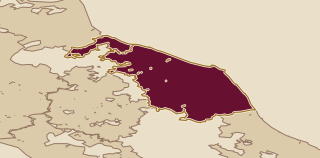
Marche runs down the Adriatic side of the Apennines, and the Piceno is its southernmost hill zone. Castel di Lama and Offida sit in the Ascoli Piceno province, where the hills are steep enough to slow ripening but warm enough to bring Montepulciano to full colour. The legal framework adds specificity: Offida DOC, a sub-zone appellation carved from the broader Piceno geography, permits only two grapes as varietal still wines, Passerina and Pecorino, both whites. Montepulciano travels under the Rosso Piceno DOC and its more concentrated sibling, Rosso Piceno Superiore DOC. Falerio DOC, a blended white appellation for the same zone, takes Passerina as a component.
The two municipalities in the estate's vineyard holdings are not adjacent. Castel di Lama is closer to the Tronto river valley; Offida sits higher and further south. The distance matters because it gives the estate access to more than one expression of the same variety grown in the same appellation framework.
In the cellar
Vineyards and cellar
Every vineyard carries permanent grass cover between the rows. Grass cover holds moisture and slows nutrient cycling, which keeps vine vigour in check across the growing season. The estate also limits the number of bunches each vine carries, a yield-reduction choice that concentrates flavour in the fruit that remains. Both practices are common in low-intervention viticulture; at Tenuta De Angelis they are part of a certified organic system rather than a marketing position.
Harvest is done by hand. Grapes are selected and sorted in the vineyard rather than on a sorting table back at the winery, with the picker deciding in the row which clusters are destined for which winemaking project. The approach requires more labour but gives each wine a cleaner raw material before fermentation begins.
Wines to know
The range in view
Passerina is the grape that carries the estate's international profile. The varietal still white under the Offida DOC is the most widely distributed wine: a single-grape bottle made entirely from Passerina, certified organic, and light enough in body to work as a straightforward drinking white. The same grape appears in a long-Charmat Extra Brut sparkling wine, where secondary fermentation happens in a pressurised tank rather than a bottle, and as a component of Falerio DOC, a blended white appellation where Passerina shares the blend with other permitted Piceno white varieties.
Pecorino Offida DOC is the second white. Pecorino carries higher natural acidity and more aromatic intensity than Passerina. Where Passerina in the glass is typically light and citrus-forward, Pecorino tends to be more assertive, with a fuller body and more obvious grip on the finish. Both grapes are white; both carry the Offida DOC; they are not interchangeable.
A useful way in
A bottle to begin with
Start with the Passerina Offida DOC still white. It is a single-variety, certified organic wine made entirely from Passerina grown across the estate's Castel di Lama and Offida vineyards. The grape is native to southern Marche and the Piceno is its home appellation: the Offida DOC was constructed in part around Passerina, which means this bottle sits at the intersection of the estate's core farming commitment, its most directly identified variety, and the appellation that defines the territory. In the glass it is pale, dry, and light-bodied, with citrus and white fruit on the nose and a clean, moderately acidic finish. No oak, no sweetness, no complication.