
Why it matters
The producer
Tenuta di Argiano sits on a plateau on Montalcino's southwestern slope, at 350 metres, with 60 hectares of vineyard and a history in the appellation that runs long enough to have shaped it. When the Consorzio del Brunello di Montalcino formed in 1967, Argiano was among its founding members. Argiano has been a founding member of the Consorzio del Brunello di Montalcino since 1967.
The core wine is Brunello di Montalcino DOCG, made entirely from Sangiovese. Alongside it sits Non Confunditur IGT Toscana, a blend of Cabernet Sauvignon, Merlot, and Petit Verdot with Sangiovese, and a Rosso di Montalcino DOC, the shorter-aged Sangiovese bottling that shares grape sources with the Brunello. Sangiovese covers 42 of the estate's 60 vineyard hectares; the French varieties fill the remainder and have been planted at Argiano for decades.
Place and vineyards
Where the wines begin
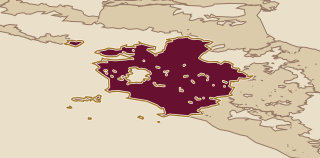
Montalcino is a hilltop town in the province of Siena, surrounded by the Brunello di Montalcino DOCG, a zone that produces age-worthy Sangiovese from soils and exposures that vary considerably depending on which slope you are standing on. The southwestern face, where Argiano lies, is warmer and drier than the northern and eastern flanks. Less cloud cover from the Tyrrhenian Sea reaches this side; rainfall is lower; the growing season runs hotter. That warmth tends to give southwestern Brunello more fruit weight and a rounder mid-palate compared to the more austere, mineral character often found on the northern and eastern slopes above Sant'Angelo in Colle or toward Castelnuovo dell'Abate.
In the cellar
Vineyards and cellar
Argiano farms under an organic-regenerative approach, with the stated goal of returning the vineyard to its natural equilibrium and supporting biodiversity across the 125-hectare estate. Organic certification was awarded in the 2016-2021 period; plastic-free operations and carbon neutrality were achieved in the same window.
The key cellar decision of the post-2013 period is the separate vinification of the six best marl-rich plots in the north-central sector. Ageing these parcels apart from the main Brunello blend allows the estate to draw out the mineral quality and firm acidity that marl tends to produce, rather than folding those parcels into a single unified wine. The 1965 parcel is the oldest and forms the backbone of the Vigna del Suolo bottling. Ageing requirements under DOCG rules shape the cellar calendar: two years minimum in oak cask, five years total before the Brunello can be released.
Wines to know
The range in view
The range has four tiers, each with a distinct relationship to Sangiovese and to the Montalcino appellation hierarchy.
Brunello di Montalcino DOCG is the estate Brunello: 100% Sangiovese, sourced from the full vineyard holding and aged to DOCG minimum. At release it carries five years of development behind it, with at least two in oak. The wine has dark fruit, firm tannin, and the acidity to develop further in bottle. Production at the time of the 2013 sale was approximately 120,000 bottles.
A useful way in
A bottle to begin with
Start with the Brunello di Montalcino DOCG. It is the wine the estate has built around since 1967, drawn entirely from Sangiovese grown on the southwestern slope at 350 metres, and held for five years before release. In the glass it gives dark cherry, firm marl-derived tannin, and a long acid line that carries the finish. It is not a light wine, and it is not built for immediate drinking: it rewards patience and food. But it is the bottle that places Argiano's Sangiovese in its appellation context most clearly, and at this scale and release volume it is the most reliably findable wine in the range.