
Why it matters
The producer
The Venerosi Pesciolini family has been at Ghizzano since 1370. That is not a marketing claim built around a founding story; it is a documented land presence that predates the modern idea of an Italian wine estate by several centuries. The winery occupies a nearly 1,000-year-old castle that evolved over the centuries into a Renaissance country villa with large cellars built of brick and stone beneath it.
Ginevra Venerosi Pesciolini took over management in 1995, having grown up watching her father, Count Pierfrancesco, begin building a more serious estate operation. She arrived and kept moving: replanting vineyards, shifting the cellar from a conventional additive-led approach toward native fermentation, and eventually converting the entire 280-hectare property to biodynamic farming. Working with consulting enologist Carlo Ferrini, she stripped out commercial tannins and acidifiers, introduced indigenous-yeast fermentation across all four wines, and removed pumps from the must-transfer process. The estate now produces approximately 80,000 bottles a year from 18 hectares of vines.
Place and vineyards
Where the wines begin
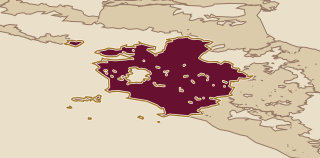
Ghizzano is a hamlet in the Pisan hills, on the western edge of Tuscany where the land slopes toward the Tyrrhenian coast. The estate sits at roughly 200 metres above sea level on rolling terrain. It is not in Chianti Classico, not in Bolgheri, and carries no appellation name that most wine buyers will recognise on sight. The labels say IGT Toscana, the broad regional designation, and nothing more specific beneath that.
For a buyer accustomed to navigating Tuscany by zone, this takes a moment to reframe. The lack of a famous DOC does not indicate a lesser wine; it indicates a producer working outside the boundaries of the established classified zones, in terrain where the family history runs longer than any of those zones' rulebooks. The Pisan hills location gives the estate a coastal climate influence, with sea air moderating summer heat and extending the growing season compared to more inland Tuscan addresses.
In the cellar
Vineyards and cellar
The harvest is done by hand, with grapes going into ventilated boxes holding no more than 20 kilograms. Small loads at harvest protect the fruit from bruising and premature oxidation before it reaches the sorting table at the winery.
The estate crushes grapes by barefoot treading in small steel containers. It is a slow, gentle method that avoids the mechanical pressure of a crusher and gives the winemaker close physical control over extraction. The must then moves to fermentation vats without pumps, relying on gravity throughout.
Wines to know
The range in view
Il Ghizzano Rosso is 95% Sangiovese with 5% Merlot, fermented in stainless steel and concrete, with the estate's characteristic foot pressing and native yeasts. It is the most accessible wine in the range, designed for fruit-forward drinking without extended ageing requirements. The Sangiovese drives cherry fruit and bright acidity; the small Merlot addition rounds the body without altering the character significantly.
Il Ghizzano Bianco is a skin-contact white made with native fermentation and the same biodynamic vineyard approach as the reds. The grape variety has not been independently confirmed in the available research, though the wine is officially described as skin-contact. A 2019 professional tasting note recorded stone fruit and citrus on the nose, a honeyed texture offset by fresh acidity, and good length. Skin contact gives the wine amber colour and a firmer, more textured palate than a conventionally pressed white.
A useful way in
A bottle to begin with
Start with Il Ghizzano Rosso. It is 95% Sangiovese from Pisan hills vines at 200 metres, fermented with indigenous yeasts, foot pressed in steel, gravity moved to tank, and made without commercial additives. The 2019 review found cranberry, blueberry and purple orchid aromas, with medium body, tart acidity, moderate tannins and a persistent round finish. It shows what the estate's cellar philosophy produces when applied to an undemanding grape blend in an approachable style, and it does so without requiring the commitment of a premium bottle. For anyone curious about the estate's biodynamic farming and additive-free winemaking, this is where to start.