
Why it matters
The producer
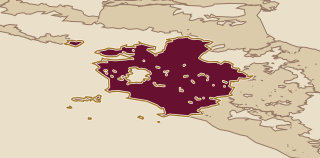
Bibbona sits close to the Tyrrhenian coast in Livorno province, a corner of Tuscany better known for olive groves and beach towns than for wine estates. Tenuta Elmata arrived here in 2020, when the Paus family registered the estate in September of that year, formalising a project that had begun three years earlier with the purchase of a villa. The property now holds about ten hectares in total, with three hectares already producing and a further two and a half hectares planted during 2024 and 2025.
The estate runs three wines: Nippi, a Sangiovese-led Toscana Rosso; La Ribelle, a white from Sauvignon Blanc; and Elmata, a red built from the Bordeaux varieties on the property. Organic certification, under the Italian Biologico classification, arrived in summer 2025.
Place and vineyards
Where the wines begin
Bibbona lies in the Livorno province on Tuscany's western coast, where proximity to the sea shapes the growing season. The coastal position brings a consistent breeze off the water, which moderates summer temperatures and keeps humidity in check during ripening. For Sangiovese, that maritime influence extends the window between flowering and harvest, allowing the grape to build acidity alongside its fruit.
The Nippi plot sits two kilometres from the estate villa, close to Bibbona's old mill. Two other plots, Colombaia and La Ribelle, face the sea directly and receive a stronger breeze, conditions that suit the Sauvignon Blanc planted on La Ribelle.
In the cellar
Vineyards and cellar
The estate's roughly ten hectares divide between an established producing block and substantial new plantings. The Nippi plot, around four and a half hectares in total, holds the oldest vines on the property, just over one hectare aged between ten and fifteen years, alongside the newer rows installed in 2024 and 2025. Colombaia was planted in spring 2021 and was expected to produce its first fruit in 2023. La Ribelle, neighbour to Colombaia and planted with Sauvignon Blanc, faces the sea and catches the coastal breeze.
Wines to know
The range in view
Nippi is the estate's central red, a Toscana Rosso with Sangiovese accounting for 85 percent of the blend from the 2023 vintage onward, with five percent each of Merlot, Cabernet Sauvignon, and Cabernet Franc. The inaugural 2022 release used a Sangiovese-dominant blend with an unspecified proportion of other local grapes; the 2023 vintage fixed the formula at four named varieties. The wine is bottled as Toscana IGT, using the broad regional designation rather than a sub-zone name, which gives the estate flexibility with its mixed planting.
La Ribelle is the estate's white, made from Sauvignon Blanc grown on the sea-facing plot. Elmata is the full-bodied red from the Bordeaux varieties on the property. Together the three wines cover the main plantings: Sangiovese at the centre, the Bordeaux reds contributing to both Nippi's minority share and the Elmata blend, and Sauvignon Blanc standing alone in La Ribelle.
A useful way in
A bottle to begin with
Nippi draws on the oldest vines on the property, just over a hectare aged ten to fifteen years at the Nippi plot two kilometres from the villa, and it carries the split élevage that defines the estate's cellar approach: Sangiovese in concrete to preserve fruit freshness, the Bordeaux minority in second-use barriques for depth. Nippi is a light-to-medium Tuscan red with red berry fruit, dried fig, lively acidity, and a savoury herb note that comes through on the finish.