
Why it matters
The producer
The Forno family has worked the hills around Santo Stefano Belbo since the mid-seventeenth century, and Tenuta il Falchetto carries that continuity into six separate vineyard estates today. Pietro Forno drew the first clear line between bulk grower and estate producer in 1940, when he began bottling Moscato under the family name rather than selling it in barrels. That decision set the direction: Moscato Bianco would be the heart of the range, grown in the Canelli subzone of the Moscato d'Asti DOCG.
Three brothers now lead the estate: Giorgio, Fabrizio and Adriano Forno. Six holdings spread across the provinces of Cuneo and Asti give the range its breadth, covering two DOCGs with distinct characters: Canelli for aromatic, low-alcohol Moscato, and Nizza for Barbera with depth and age behind it. All pruning, canopy work and picking is done by hand across every estate.
Place and vineyards
Where the wines begin
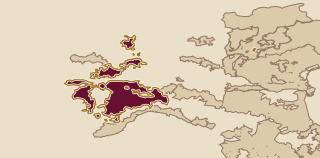
Santo Stefano Belbo sits in the Belbo river valley in the southern Langhe, at the point where the hills of Cuneo province meet those of Asti. This is Moscato country: the Canelli subzone of the Moscato d'Asti DOCG covers a concentration of south-facing hillside vineyards where Moscato Bianco ripens fully but retains the acidity the grape needs for balance. The bottle labelled Canelli DOCG carries a geographic claim inside the appellation name, signalling grapes from this specific cluster of communes rather than the broader Asti province.
In the cellar
Vineyards and cellar
Every vine on every estate is managed by hand. Pruning decisions, canopy adjustments and harvest picking are done manually rather than mechanically, which matters most in the Moscato parcels, where selective picking allows the team to choose grapes at the moment their sugar and acidity are in balance rather than harvesting the whole parcel at once.
The cellar uses two different oak formats depending on the wine. Thirty-hectolitre oak casks give red wines slow, gradual integration with wood without imposing heavy tannin or obvious oak character; 225-litre French barriques from multiple cooperages add more wood contact for wines built for longer ageing. The choice of cooperage source matters because different forests and different toasting levels produce different aromatic and structural results in the finished wine.
Wines to know
The range in view
The range divides cleanly into three appellations, each with its own grape and purpose.
Moscato d'Asti DOCG and Asti Spumante DOCG, from Canelli-subzone parcels, are the editorial core. The Tenuta del Fant is the flagship Moscato cuvée, from the Calosso estate at 350 metres. It is lightly sparkling (frizzante rather than fully sparkling), sweet, and low in alcohol. The nose carries fresh fruit, flowers, citrus and sage; the palate is sweet but not cloying because the wine's acidity and a quality the producer describes as sapidity keep the sugar in motion. A second Moscato cuvée, Ciombo, comes from Santo Stefano Belbo parcels and sits alongside Tenuta del Fant in the range.
A useful way in
A bottle to begin with
Tenuta del Fant Moscato d'Asti DOCG (Canelli subzone) is lightly sparkling and sweet. Grown at 350 metres in Calosso, made from Moscato Bianco in the Canelli subzone with its specific geographic designation within the broader appellation, it is lightly sparkling, sweet, and low in alcohol: white peach, orange blossom, citrus, and sage, with an acid line that keeps the sweetness from sitting flat. The Canelli label is worth noting: it is a subzone of Moscato d'Asti DOCG that specifies origin more precisely than the broader appellation, and Falchetto's Moscato parcels sit within it. This is not a wine built for ageing or for a main course; it is built for a precise moment.