
Why it matters
The producer
Tenuta J. Hofstätter is a four-generation family wine estate based in Tramin, in the Alto Adige wine region of northeastern Italy. The estate started as a winery attached to an inn in 1907 and has grown into one of Alto Adige's larger family operations, with roughly 124 acres of vineyards spread across both banks of the Adige Valley and south into the Piccole Dolomiti foothills of Trentino.
No other family winery in Alto Adige holds vineyards on both sides of the Adige River. That cross-valley position gives Hofstätter access to genuinely different soils, slopes, and grape possibilities on each bank: the estate grows indigenous Alto Adige varieties such as Gewürztraminer, Lagrein, and Schiava alongside Pinot Noir, Pinot Blanc, and Sauvignon Blanc, then adds cool-climate Chardonnay and Pinot Noir from Trentino at elevations above 800 metres. The range runs from pale, low-tannin Schiava in the valley to structured single-vineyard Pinot Noir from hillside parcels, covering nearly the full span of what the two provinces can produce.
Place and vineyards
Where the wines begin
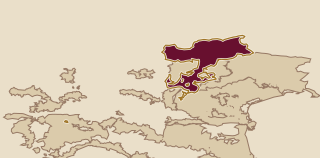
Alto Adige sits at the northern tip of Italy, in a mountain valley running south from the Austrian border. The Adige River cuts through a broad glacial corridor flanked by steep slopes, and the vineyards cluster on the valley walls and terraces where cool nights and intense mountain sun shape every growing season. The Italian and German names for towns run parallel here, reflecting the region's dual inheritance: Tramin and Termeno, Mazon and Mazzon, and so on through the label.
Hofstätter's Alto Adige holdings span four villages: Mazon (Mazzon) on the eastern flank, Tramin (Termeno) and Söll (Sella) on the western bank, and Buchholz (Pochi) further into the valley. The two banks sit in different sun exposures and carry different soils, which is why Gewürztraminer thrives in Tramin while Pinot Noir from Mazon produces a distinctly different wine from the same grape grown a few kilometres across the valley.
In the cellar
Vineyards and cellar
Vineyard management relies on gentle pruning and the establishment of cover crops between the vine rows. Cover crops build organic matter in the soil, moderate vine vigour, and encourage root development. The result in the glass is grapes with natural concentration rather than forced extraction.
The cellar uses both wooden barrels and concrete vats for ageing. Concrete keeps wines at a stable temperature without imparting oak character, preserving aromatic freshness in the whites and lighter reds. Wooden barrels add a degree of micro-oxygenation suited to the more tannic varieties, including Lagrein, which has the weight to absorb wood ageing without losing its dark-fruit profile. Each single-vineyard Vigna bottling is vinified separately from reception, so the character of each parcel drives the wine rather than being blended away into a multi-site cuvée.
Wines to know
The range in view
The J. Hofstätter range divides broadly into estate wines and single-vineyard Vigna bottlings, with the latter representing individually named parcels from specific villages.
Kolbenhofer Schiava is a pale, low-tannin red from Schiava, the indigenous light-red grape of Alto Adige grown in the valley-floor villages. Fresh red fruit, a light body, and an easy texture characterise the style: Schiava ripens early, carries little colour, and produces wines that drink immediately.
A useful way in
A bottle to begin with
Start with Kolbenhofer Schiava. Schiava is indigenous to Alto Adige and almost invisible outside it, and the Kolbenhofer is the clearest picture of what the valley floor and the local grape produce together. The wine is pale in colour, low in tannin, and built around fresh red fruit: strawberry, a little cherry, a light floral note. The body is light and the finish is short and clean. Nothing about it resembles a conventional Italian red, which is exactly the point. A bottle of Kolbenhofer tells you what Alto Adige grows when it grows what it has always grown, before Pinot Noir or Lagrein became the calling cards of the region internationally.