
Why it matters
The producer
The Brigl family acquired the Kornell property in Settequerce in 1927, a village in the South Tyrol wine district at the northern edge of Italy. The property itself has a documented winegrowing history extending more than 700 years. When Florian Brigl took over management in 1996, he inherited that long record and added a specific ambition: to make a serious Alto Adige Merlot that could sit beside the wines of Pomerol. Winemaker Marco Chisté joined him in the cellar to pursue it.
The estate has two distinct wine programmes. On one side, a broad white range drawn from the varieties that have always defined South Tyrol. On the other, a red programme concentrated on Merlot and expressed most clearly in Marith, a single-variety Pinot Noir sourced from the Mazzon district in Caldaro.
Place and vineyards
Where the wines begin
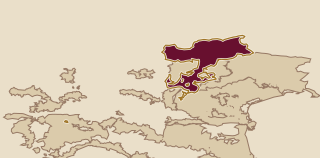
Alto Adige sits in Italy's far north, bordered by Austria and Switzerland, and the wine district carries dual heritage: the labels often appear in both Italian and German, and the appellation is legally South Tyrol DOC. Settequerce lies in the valley floor near Terlano, a few kilometres south of Bolzano.
Kornell's vineyards spread across three sites: Settequerce itself, Appiano-Monte to the south, and Kampenn to the north, with the regional wine body's confirmed Brigl-family holdings sitting between 270 and 550 metres. The Marith Pinot Noir draws from a fourth location: Mazzon, a named subzone within the Caldaro commune east of the Adige river, where west-facing slopes reach from 350 to 900 metres. The altitude range across all sites, combined with 2,100 annual sunshine hours and reliably cool nights, keeps acidity intact through full ripeness. The South Tyrol DOC covers the estate's full red range, including Marith.
In the cellar
Vineyards and cellar
Kornell farms the 11 confirmed Brigl-family hectares across Settequerce, Appiano-Monte, and Kampenn, with the Mazzon parcels in Caldaro providing the Pinot Noir fruit for Marith. Vineyard management centres on soil health: cover crops hold the steep hillsides between rows, organic fertilisers replace synthetic inputs, and gentle mechanical cultivation avoids compaction on the porphyry terraces.
In the cellar, the approach for the broader red range is extended oak ageing. Fermentation happens in stainless steel, followed by 14 to 18 months in a combination of small oak casks and larger oak barrels, and then nearly ten further months in bottle before release. Marith follows a different path: fermentation in large oak vats, then seven months in large oak casks, with shorter contact time giving the Pinot Noir less toasted wood influence and more open fruit. Marco Chisté makes both calls.
Wines to know
The range in view
The Kornell range divides cleanly into whites and reds. Whites include Pinot Blanc, Sauvignon Blanc, Pinot Grigio, and Gewürztraminer, varieties well established in South Tyrol's valley and hillside appellations. They are built for the high-altitude, high-acidity character of the region: lifted aromatics, firm acids, and the kind of dry fruit clarity that comes from long, cool ripening.
The red range opens with Lagrein and Cabernet Sauvignon before arriving at Merlot, which Florian Brigl has positioned as the estate's leading wine over the past three decades. Kornell's Merlot spends 14 to 18 months in mixed oak. It is not a quick-turn red: the ageing programme is designed to produce depth and the bottle weight that Brigl associates with Pomerol.
A useful way in
A bottle to begin with
Start with Marith. It is a South Tyrol DOC Pinot Noir from Mazzon in Caldaro, a district with west-facing slope exposure, gravel and clay soils, and vine rows at 350 to 900 metres. The wine ferments in large oak vats and spends seven months in large oak casks before release. In the glass it is medium-bodied with fine tannins, a dry red-fruit core, and a clean, slender finish pulled along by the altitude acidity from Mazzon. Marith is made from Pinot Noir grown in Mazzon.