
Why it matters
The producer
The estate takes its name from a Flemish cloth merchant. Pietro Jescot owned the land at Cioccaro di Penango around the turn of the seventeenth century, and the Italian word for Flemish, fiammenga, became the property's name. Four centuries later, cousins Paolo and Guido Sartirano, fourth-generation wine producers, run the same land. They farm 30 hectares organically on the Asti side of Monferrato, grow Barbera, Grignolino and Freisa alongside Cabernet, Merlot and Sauvignon, and make their wines from estate-grown fruit harvested by hand.
Commercial production began in 2001. The estate's flagship is Pajon, a Barbera d'Asti DOCG Superiore made from 100% Barbera, fermented whole by a method Paolo Sartirano calls vinificazione materica: the grapes are destemmed without being crushed and fermented slowly in 500-litre tonneaux with prolonged skin contact. It goes well beyond the region's lighter, everyday style.
Place and vineyards
Where the wines begin
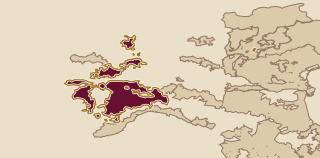
Cioccaro di Penango sits on the Asti side of Monferrato, the broad hill country of southern Piemonte that runs south and east from the Langhe. Monferrato is not a single appellation but a landscape that contains several: Barbera d'Asti DOCG covers much of the southern section, and Superiore wines have more body and concentration than standard Barbera d'Asti. Grignolino is one of the traditional varieties grown at the estate.
The Asti side of Monferrato places the estate on clay-rich terrain that holds warmth and moisture through the growing season. Barbera planted here tends toward dark, full-bodied wines with high natural acidity, which makes the grape well suited to the kind of prolonged maceration that vinificazione materica applies.
In the cellar
Vineyards and cellar
All 30 hectares are farmed organically, with 25 hectares in productive vines or undergoing replanting. Harvest is manual with careful selection of ripe bunches at pick, which gives the cellar clean, sorted fruit. The variety mix spans both traditional Piemontese grapes and international varieties: Barbera, Grignolino and Freisa on one side; Cabernet, Merlot and Sauvignon on the other.
In the cellar, vinificazione materica defines the house approach for Barbera. The grapes are destemmed without crushing, preserving the berry intact, then moved into 500-litre tonneaux where fermentation proceeds slowly with the skins in prolonged contact with the must. The tonneaux size sits between a standard barrique and a large foudre, giving gentle oxygen exchange without dominating the fruit with wood character. The slow fermentation extracts colour and tannin gradually, producing a wine with firm body and deep colour rather than the bright, light style associated with quickly fermented Barbera. No artificial clarification or aggressive filtration interrupts the process.
Wines to know
The range in view
The range centres on Piemontese appellations. Pajon, the estate flagship, is classified as Barbera d'Asti DOCG Superiore: 100% Barbera, made by vinificazione materica. At 15% alcohol, it is a dense wine with dark fruit, a balsamic note, firm body and the characteristic bright acidity that keeps Barbera alive despite its weight.
Grignolino d'Asti, one of the estate's founding wines from 2001, is a varietal wine made from estate-grown Grignolino, one of the estate's traditional Monferrato grapes, with ripe bunches selected by hand.
A useful way in
A bottle to begin with
Start with Pajon, Barbera d'Asti DOCG Superiore. It is 100% Barbera from organically farmed Monferrato clay, made by vinificazione materica: whole destemmed berries, 500-litre tonneaux, slow fermentation, prolonged skin contact. The wine comes out dark ruby with dense fruit, violet and balsamic on the nose, firm body and high-tannin grip unusual for the appellation, and a long savoury finish kept alive by Barbera's natural acidity. It runs at 15% alcohol with no sense of heat. Pajon is where the cellar method and the grape's character are most fully expressed, and where the estate's distance from lighter, quicker Barbera d'Asti styles is most clear.