
Why it matters
The producer
Tenuta La Pergola farms Nebbiolo, Barbera, Arneis, and Croatina from the village of Cisterna d'Asti, in a corner of Piemonte that most wine buyers pass over in favour of the Barolo communes to the south or the Barbaresco villages to the north. The Bodda family has worked this land for four generations and holds SQNPI certification, the Italian national scheme for sustainable viticulture and integrated pest management.
Alessandra Bodda has led the estate since 2001. Her children have since joined, and the range now carries three distinct lines that reflect that generational layering: Tradizione, the base expression of native varieties in a traditional style; Prestigio, the prestige tier centred on the Terre Alfieri DOCG Nebbiolo Superiore; and MINIFIOR, a fresher, lighter-drinking line brought in by the younger generation. The Terre Alfieri DOCG Arneis and Nebbiolo Superiore are the estate's clearest flag-bearers, both named for the home appellation.
Place and vineyards
Where the wines begin
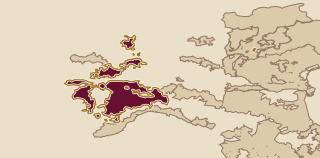
Terre Alfieri is a DOCG covering hilly terrain in the provinces of Asti and Cuneo, set between the better-known zones of the Roero, Monferrato, and Langhe. Cisterna d'Asti, where Tenuta La Pergola's winery sits at Località San Matteo, lies at roughly the geographic midpoint of this corridor. That position matters for the bottles: the estate draws from three overlapping sets of hills rather than one dominant slope, and its appellation spread reflects that breadth.
For Nebbiolo grown here under the Terre Alfieri DOCG, the estate presents the wine as a red made from Nebbiolo. Altitude and aspect vary across the corridor, and the DOCG rules allow both a standard Nebbiolo and a Superiore designation, the latter requiring extended ageing before release. Arneis, the white grape of the Roero, also grows in Terre Alfieri and appears in the estate's range alongside the Roero DOCG Arneis bottling.
In the cellar
Vineyards and cellar
The estate farms under SQNPI certification across its parcels in the Terre Alfieri zone. SQNPI is Italy's integrated production scheme: it limits synthetic inputs, sets canopy management standards, and requires documentation of farming decisions across the season. For Nebbiolo grown under this programme, the practical effect is careful management of yields and ripeness, since the grape is sensitive to both over-cropping and late-season rot.
Wines to know
The range in view
The range runs across five appellations and four grapes, organised into three lines. The Tradizione bottles present Nebbiolo, Barbera, and Arneis in their most direct form, without extended ageing or prestige-tier selection. The Prestigio tier includes the Terre Alfieri DOCG Nebbiolo Superiore as its anchor red, with Barbera d'Asti DOCG Superiore and Roero Arneis DOCG in supporting roles. The Superiore designation on both the Nebbiolo and the Barbera signals longer ageing before release.
The MINIFIOR line sits apart from the other two in style and intent. Introduced by the younger Bodda generation, it targets earlier drinking and freshness rather than the depth and ageing potential the Prestigio wines pursue. The grape and cuvée detail within MINIFIOR is not fully documented, but the line's position in the range makes it the lightest and most approachable tier.
A useful way in
A bottle to begin with
Start with the Terre Alfieri DOCG Nebbiolo Superiore. It is the estate's prestige-tier red, 100% Nebbiolo from the home appellation, aged in large Piemontese botti before release under the Superiore designation. The wine is dry and built for the table rather than solo drinking: dried rose and dark cherry on the nose, firm tannin in the mouth, a long acid-led finish. It is not Barolo, and it does not try to be. What it does is show what Nebbiolo grown in Terre Alfieri, at this altitude and in this family's hands, actually tastes like, which is a more specific thing than the grape's general reputation suggests.