
Why it matters
The producer
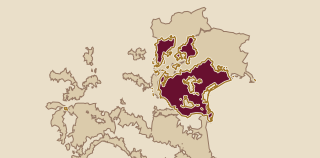
Tenuta Lamborghini sits between the southern shore of Lake Trasimeno and the medieval hilltop village of Panicale, in the Umbrian province of Perugia. The Umbria-Tuscany border runs close by, with Cortona and the Val di Chiana a few dozen kilometres to the north. The car manufacturer shares the name because the connection is direct: Ferruccio Lamborghini, who built the tractor and supercar businesses, bought this estate in 1968 and farmed it seriously.
What makes the estate more than a famous surname is the wine decisions that followed. Ferruccio planted Merlot and Cabernet Sauvignon alongside the local Sangiovese and Ciliegiolo at a time when international varieties were unusual in this part of central Italy. After his death in 1993, his daughter Patrizia took management in the mid-1990s and called in Riccardo Cotarella, one of Italy's most respected winemakers, to lead a quality rebuild from the vine up. More than 20 hectares were replanted with selected Sangiovese and Merlot clones. The estate now sells into more than 80 countries, with travel-retail expansion underway as of 2025.
Place and vineyards
Where the wines begin
Umbria is a landlocked region in central Italy, and the Trasimeno area where the estate sits is defined by the lake's moderating effect on temperature. The elevation and the proximity to Tuscany pull the climate toward warm days and cooler nights than the lower Umbrian valleys, conditions that slow ripening and preserve acidity in the grapes. The estate's 32 wine-producing hectares occupy a gentle landscape that softens the bolder warmth further south.
The Umbria IGT designation on the estate's reds is a geographic label that covers the whole region and imposes no grape restrictions, which is why blending Merlot and Cabernet Sauvignon with Sangiovese is permitted and labelled correctly. The flexibility matters: it allowed Ferruccio to plant what he wanted in 1968 and allows the estate today to build blends that draw on both local and international varieties without reclassifying the wine.
In the cellar
Vineyards and cellar
The estate's 32 vineyard hectares carry a mix of varieties planted across two eras: Ferruccio's original selections from the late 1960s and the post-1993 replanting programme that prioritised Sangiovese and Merlot clones. The clone selection from the 1990s onwards was aimed at tighter fruit concentration and better site expression rather than higher yields.
For the classic red range, the grapes go through French-oak barrique maturation after fermentation. Barriques, the 225-litre casks standard in Bordeaux and much of Tuscany, add dark spice and a degree of oak character to the wine and accelerate the integration of tannins from Cabernet Sauvignon and Merlot in particular. The classic reds mature in French-oak barriques and remain within an Umbrian IGT frame.
Wines to know
The range in view
The core red range blends Sangiovese, Merlot and Cabernet Sauvignon under the Umbria IGT designation. The Sangiovese brings dried cherry and firm acidity; the Merlot softens the mid-palate and adds plum and cassis weight; the Cabernet Sauvignon contributes dark herb and grip on the finish. French-oak barriques give the range its consistent dark spice and smooth tannic frame. These are fuller-bodied reds made to carry flavour and age moderately.
Luxe Grechetto is made entirely from Grechetto, a white grape with roots in Umbria and Lazio. The variety gives moderate-bodied whites with herbal and stone-fruit character, peach and white flower on the nose, and a slightly bitter almond note on the finish that is typical of the grape. The wine sits in a different register from the reds: lighter, more direct, with freshness and savouriness.
A useful way in
A bottle to begin with
Start with the Umbria IGT red blend. It is the bottle that carries every core decision the estate has made: the 1968 plantings, the Cotarella quality shift, the selected-clone replanting, and the French-oak maturation. In the glass, expect dark cherry, plum and black herb on the nose, a round mid-palate where the Merlot holds the texture, and a long finish with firm Cabernet Sauvignon tannin and a note of cedar from the oak. The wine is full-bodied and warm. It arrives in the octagonal bottle that the estate treats as its physical signature. Begin here.