
Why it matters
The producer
Tenuta Le Colonne farms 61 hectares of certified organic vines in Donoratico, on the flat coastal strip of Bolgheri where the land runs out toward the Tyrrhenian Sea. It is one of the Bolgheri wineries closest to the water, and the soils underfoot are predominantly sandy, a contrast to the clay and gravel that defines the hillside estates farther inland.
Argentine entrepreneur Alejandro P. Bulgheroni built his Tuscan positions from the interior outward, starting in Chianti Classico, then Montalcino, then arriving in Bolgheri in 2016. At Bolgheri he invested in two estates at once: Tenuta Le Colonne in the lower, seaward position, and Tenuta Meraviglia higher up on volcanic soils. The agronomist is Lorenzo Bernini; the enologist is Luigi Temperini. Together they manage a range built to express what the coastal sandy ground produces when farmed with minimal intervention.
Place and vineyards
Where the wines begin
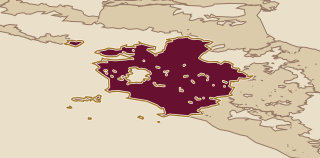
Bolgheri is a DOC appellation on the Tuscan coast in the province of Livorno, carved out of the broader Maremma and built on the reputation of Cabernet and Merlot blends. The appellation runs from the Via Aurelia toward the wooded hills, and within it, elevation and soil type change quickly. Most of the hillside estates sit higher, where clay and gravel retain warmth and push tannin and weight into the wines.
Tenuta Le Colonne sits lower than those estates, in the coastal plain near Donoratico. The sandy soils drain fast, warm quickly, and produce grapes with softer tannin and brighter aromatic lift than hillside Bolgheri typically delivers. Proximity to the sea moderates temperature, extending the growing season and keeping acidity in the fruit. On the label, the address means Bolgheri Rosso DOC and Bolgheri Superiore DOC for the reds, and Toscana IGT for wines that fall outside the DOC's varietal rules, including the Vermentino.
In the cellar
Vineyards and cellar
The 61 hectares are certified organic and farmed with a regenerative emphasis on soil vitality. The team works to build microorganism populations in the soil and to encourage vine roots to push deep into the sandy subsoil rather than feeding at the surface. Parcels carry varying aspects across the estate, which creates differences in ripening and allows the winemaking team to select from material with slightly different fruit characters.
In the cellar, native yeasts drive spontaneous fermentation. The Bolgheri Rosso ferments in cement vats for approximately 13 days. Cement holds temperature evenly and adds nothing to the wine, letting the fruit and soil character from the sandy parcels come through clearly. The Vermentino is pressed gently and fermented in stainless steel, then aged in stainless for three months, protecting the aromatic freshness of the grape.
Wines to know
The range in view
The range moves from coastal white to structured red in four steps.
The Vermentino IGT is 100% Vermentino, fermented in stainless steel for approximately 12 days and aged three months in stainless before bottling. It is the only white in the range and the wine that sits furthest toward the sea, where the sandy soils and marine air give the grape its aromatic register.
A useful way in
A bottle to begin with
Start with the Bolgheri Rosso DOC. The blend of Merlot, Petit Verdot and Cabernet Franc, fermented with native yeasts in cement, gives an honest account of what the sandy coastal soils at Le Colonne produce: softer tannin than hillside Bolgheri, bright acidity from the sea-facing position, dark cherry and violet from the Petit Verdot, and a herbal freshness from the Cabernet Franc that keeps the wine moving on the finish. It is not trying to be weighty or age-worthy. It is a coastal red from sandy ground, and at this level the estate's character comes through without requiring the patience that Plenum or the Superiore demand.