
Why it matters
The producer
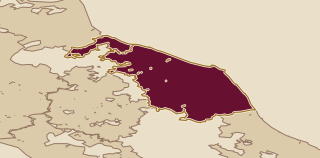
Poderi San Lazzaro sits on a hilltop 290 metres above the town of Offida in the Marche region of central Italy. The estate farms 9.5 hectares of vines across south, southwest and northwest-facing parcels, with plots that range from 15 to 60 years old. The grape lineup covers both the native white grapes of the Marche coast, Passerina and Pecorino, and the red DOC varieties Montepulciano and Sangiovese, with Grenache added to a parcel near the winery.
Paolo Capriotti and his wife Elisetta run the estate. Paolo's father Lorenzo founded it, buying a farm in the Offida hills after years of hard work, planting Montepulciano, Sangiovese and Passerina from the start. Paolo and Elisetta took over in 2003 and changed nearly everything except the hilltop.
Place and vineyards
Where the wines begin
Offida is a small town in the province of Ascoli Piceno, in the southern part of Marche. The estate sits 15 kilometres from the Adriatic Sea and 25 kilometres from the Apennines, a position that shapes the climate directly: maritime air moves inland from the coast while the hills moderate the heat that builds against the Apennine foothills. The resulting growing conditions lean toward good natural acidity in the whites and steady ripening in the reds.
The Offida appellation carries two DOCG designations for white grapes, Offida Passerina DOCG and Offida Pecorino DOCG, both named for native varieties grown in and around the town. The red framework is the Rosso Piceno Superiore DOC, one of the older appellations in Marche, which requires a blend of Montepulciano and Sangiovese grown in the Ascoli Piceno hills. Both layers of classification appear in the Poderi San Lazzaro range.
In the cellar
Vineyards and cellar
The 9.5 hectares span plots aged between 15 and 60 years. The oldest parcels contribute concentration and vine depth; the younger blocks, planted by Paolo and Elisetta after 2003, include the Pecorino and Grenache additions.
Organic practices govern both vineyard and cellar work across the estate. The most detailed cellar information available covers Pistillo, the varietal Pecorino: it ferments at 15 degrees Celsius over two weeks, a cool, slow fermentation that preserves aromatic clarity in the grape, then the wine is racked and transferred to oak barrels for ageing. The oak adds body and a degree of texture to a grape that can otherwise run lean and citrus-edged.
Wines to know
The range in view
The range has five confirmed bottles. Corolla is the Offida Passerina DOCG white, made from Passerina, a native Marche grape that tends toward light body, lemon and apple fruit, and firm acidity. Pistillo is the Offida Pecorino DOCG white, a varietal wine from 100 percent Pecorino, fermented cool and aged in oak. Pecorino is a different grape from Passerina: fuller in body, with herbal and stone-fruit character alongside the acidity that marks most Marche whites.
Podere 72 is the Rosso Piceno Superiore DOC red, a blend of Montepulciano and Sangiovese named for the estate parcel. Montepulciano in the Marche tends toward dark cherry, firm tannin and good colour; Sangiovese brings acidity and savouriness to the blend.
A useful way in
A bottle to begin with
Pistillo, the Offida Pecorino DOCG, is the right first bottle. Pecorino is one of the native Marche white grapes that most buyers outside Italy have not yet tried, and Pistillo shows what the grape does when handled carefully: cool fermentation at 15 degrees Celsius over two weeks, followed by oak ageing that adds body without burying the fruit. Pistillo is made from 100 percent Pecorino, ferments at 15 degrees Celsius for two weeks, and is aged in oak barrels. It is a grape worth knowing, and this is a clean introduction to it.