
Why it matters
The producer
A former monastery on the left bank of the Adige has been the Guerrieri Gonzaga family residence for more than three centuries. The estate sits in the village of San Leonardo in Sarnis, a name that appears in documents from 1215, tucked into the southern end of Trentino where the Alps funnel both Alpine cold and the warmth rising off Lake Garda. It is from this unlikely thermal pocket that the family makes its flagship red: a Bordeaux-variety blend that remains one of the most argued bottles in northern Italy.
Carlo Guerrieri Gonzaga is the figure who fixed the wine's direction. He studied oenology in Lausanne, then made a series of research trips to France and Tuscany that changed what he wanted to grow. Those Tuscan years brought him into a long association with Mario Incisa della Rocchetta, the man behind Sassicaia, and Carlo returned to the Adige valley with the conviction that Bordeaux grapes could do something serious at San Leonardo. His son Anselmo now directs the winery, holding to the same approach.
Place and vineyards
Where the wines begin
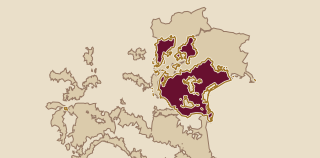
Trentino runs north from Verona toward the Brenner Pass. San Leonardo in Sarnis sits near its southern edge, where the Adige valley opens enough to let Lake Garda's moderating warmth travel up the valley floor. The Alps close off cold northern air. The Alps protect the estate from cold northern winds, and nearby Lake Garda contributes warmth. Bordeaux grapes struggle in cooler Trentino valleys further north; here they find the conditions they need.
The village name predates any current political or wine-law boundary by centuries, first documented in 1215. The estate produces wine outside the prestige DOC classifications that organise much of Trentino, which means the San Leonardo red carries the more flexible IGT designation rather than a named Trentino DOC. The label is the draw; the classification is not the point.
In the cellar
Vineyards and cellar
Organic farming across the 30 vineyard hectares means no synthetic herbicides or pesticides reach the Lessini slopes. The Biodiversity Friend framework goes further, requiring the estate to actively maintain habitat for pollinators and other species across the wider property. Certification under Equalitas evaluates environmental, economic, and social criteria together, not farming practice alone.
In the cellar, the red wines ferment without cultured yeast. Fermentation starts spontaneously in concrete vats, runs for 15 to 18 days, and involves regular pumpovers and délestage, the technique of draining the fermenting juice away from the grape solids and then returning it, which breaks up the cap and extracts colour and tannin more gently than continuous pumping. After fermentation, the wines move to an underground barrel cellar built in 2001, where they spend at least 24 months in small oak barrels before release.
Wines to know
The range in view
San Leonardo produces two principal wines. The flagship is the San Leonardo, a red built from Bordeaux varieties. Cabernet Sauvignon, Cabernet Franc, and Merlot form the frame, though the estate does not confirm precise percentages. The wine spends a minimum of two years underground in small oak, which integrates the oak into the wine's spice and earthy layers without overwhelming the fruit. At its best, the tannins are firm and fine-grained rather than heavy, and the freshness from the altitude sits alongside the riper, darker notes that the warm valley produces.
Vette di San Leonardo is a varietal Sauvignon Blanc. The 2024 vintage received a Wine Spectator tasting note; the style runs toward aromatic lift with citrus and herb rather than the richer, oakier profile of some Italian Sauvignon Blanc. A Carmenère cuvée also exists in estate materials, suggesting the family has explored other Bordeaux varieties beyond the flagship blend, though it sits at the edge of the documented range.
A useful way in
A bottle to begin with
Start with the San Leonardo red. It is a Bordeaux-variety blend grown on organically farmed mountain slopes, fermented without cultured yeast in concrete, and aged for at least two years in small oak underground before release. Nothing about that combination is accidental: Carlo built it from first principles after years of formal training and time alongside Mario Incisa della Rocchetta, and every step in the cellar is designed to let the valley's particular warmth and altitude show in the glass. The wine arrives with firm, fine-grained tannins, dried spice, earthy red fruit, and a freshness that cuts against the fullness of the mid-palate.