
Why it matters
The producer
On the crest of a hill in Castagnole delle Lanze, the Bianco family's estate spreads across 70 hectares, roughly half of which are vineyard and half grassland, woodland, and trees. The estate sits in a position that is neither fully Asti nor fully Alba: it straddles the boundary between the two districts, and that between-ness carries through into the range. Mauro Bianco runs the winery; Davide Bianco is also a presence in the business.
The family's approach comes out of two explicit inheritances. From his mother Clara, Mauro took what he calls a pleasure in wine and a commitment to authenticity. From his father Ettore, he took a love of the land and of old agriculture. The motto they have settled on is "Tradition and challenge," which is not a slogan but a description of what they are actually doing: farming Nebbiolo on a hilltop between two prestigious zones and making Barbaresco on their own terms.
Place and vineyards
Where the wines begin
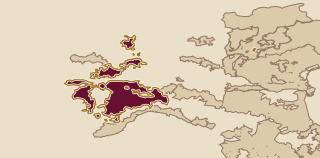
Castagnole delle Lanze is a comune in the Langhe hills of Piemonte, positioned between the Asti Monferrato zone to the north and the Alba Langhe zone to the south. Barbaresco, the DOCG appellation that covers the Bianco family's red wine ambitions, is defined territory: it runs across four communes near the town of Alba, and it is built entirely on Nebbiolo. The grape requires a particular combination of altitude, aspect, and clay-limestone soil to produce the tannic weight and aromatic depth the appellation is known for.
The San Mauro estate sits close enough to the core Alba zone to grow Barbaresco-quality Nebbiolo while remaining on a hilltop site that the family describes as varied in exposure and soil across its parcels. The 40 hectares of vineyard are not uniform. Neighbouring parcels face different aspects and stand on different ground, which is one reason the estate runs three distinct Barbaresco bottlings rather than a single blend.
In the cellar
Vineyards and cellar
All three Barbarescos are made from 100% Nebbiolo. The estate-level Barbaresco goes through 15 days of fermentation and maceration in temperature-controlled stainless-steel tanks. Temperature control during fermentation allows the winemaker to manage extraction without the risk of volatile acidity or colour instability that comes from unchecked heat. Fifteen days is a moderate maceration for Nebbiolo, long enough to pull colour, tannin, and aromatic compounds from the skins, but not so extended as to build the kind of grip that requires decades before it softens.
Cellar and ageing details for the Canova and Canova Riserva are held separately by the producer.
Wines to know
The range in view
The Barbaresco DOCG is the entry point into the range: 100% Nebbiolo, fermented in stainless steel, aged 12 months in French oak. It carries the appellation's characteristic combination of dried cherry, iron, and firm tannin, with the oak providing a spice background without dominating. The stainless steel fermentation preserves aromatic freshness; the 12-month oak maturation adds oak character.
The Barbaresco Canova DOCG steps up from there. The producer positions it as a long-ageing wine, with a development window of 20 to 25 years. In Barbaresco terms, that signals a wine with deeper tannin extraction, more concentrated fruit, and enough acid and grip to evolve rather than fade. It represents a different reading of the same Nebbiolo grape from parcels that differ in exposure and soil from those that feed the estate bottling.
A useful way in
A bottle to begin with
Start with the Barbaresco DOCG. It is the clearest window into what the estate does with Nebbiolo: 100% of the grape, moderate maceration, 12 months in French oak, and the full aromatic register of dried cherry, iron, and dried rose that defines the appellation. The tannin is genuine but approachable, the acidity keeps everything alive, and the oak sits behind the fruit rather than in front of it. It is a wine that says what Barbaresco is and what this hilltop site produces, without requiring years of waiting to make sense of it. Open it a couple of hours before serving.