
Why it matters
The producer
Tenuta Sant'Antonio is a four-brother estate in the Veneto that farms two distinct wine territories from a single base at San Briccio. Massimo, Armando, Tiziano and Paolo Castagnedi work limestone hills above Mezzane for Valpolicella and volcanic slopes near Soave for white wines, producing everything from steel-aged SCAIA bottles at the approachable end to barrel-matured Amarone at the top.
The estate is a break, deliberate and documented, from cooperative farming. Their father Antonio grew grapes for the Colognola ai Colli cooperative, a society he had helped found. In 1989, the four sons bought 30 hectares of land in the Garbi Mountains around Mezzane. Added to the 20 hectares Antonio already farmed, that purchase doubled the family's vineyard base and shifted the project from bulk fruit supply to proprietary production. The first Tenuta Sant'Antonio vintage appeared in 1995. A dedicated cellar for pressing, vinification and bottling was completed on the Garbi Mountains in 2000. A separate historic barrel cellar remains the maturation site for the flagship wines.
Place and vineyards
Where the wines begin
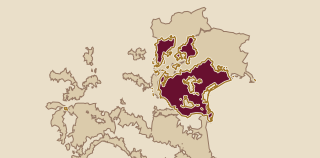
The Veneto stretches from the Alps to the Adriatic, but Tenuta Sant'Antonio's two territories are close and contrasting. Valpolicella is hill country northwest of Verona. Soave lies to the east of the city, lower and geologically different.
The Valpolicella vineyards sit at 250 to 350 metres in the Garbi Mountains. The soils are compact with a limestone skeleton, and Lake Garda breezes moderate the summer heat. This elevation and coolness matter on the label: the parcels supply Corvina, the lead grape of Valpolicella, at a ripeness level that keeps colour and tannic grip without losing the dried-fruit concentration that Amarone and Ripasso require. The appellation name Valpolicella Ripasso refers to a wine fermented again on the pressed skins of Amarone grapes, a cellar technique specific to this area that deepens body and fruit.
In the cellar
Vineyards and cellar
The brothers work the vineyards with manual bunch selection and low yields per plant. Both practices concentrate fruit at the vine rather than in the cellar: selecting bunches by hand removes under-ripe and damaged fruit before harvest, while low yields mean each vine puts its energy into fewer clusters, producing denser, more even ripeness.
In the cellar, the two brands follow different paths. SCAIA wines are aged in stainless steel, which preserves aromatic freshness and acidity in both the Garganega Chardonnay white and the Corvina red. The flagship Tenuta Sant'Antonio range uses wood ageing. The Monti Garbi Valpolicella Ripasso goes through refermentation on the pressed skins of dried Amarone grapes before moving into cask for 12 months: the contact with Amarone skins adds body, darker fruit and persistence than a standard Valpolicella achieves. The historic barrel cellar handles the extended maturation for this wine and the Amarone.
Wines to know
The range in view
The estate operates two main labels. Tenuta Sant'Antonio covers the barrel-matured wines, with the Monti Garbi Valpolicella Ripasso at the accessible end of the range and the Amarone at the top. SCAIA covers the steel-aged, lighter interpretations of the same territorial grapes.
The Monti Garbi Valpolicella Ripasso is Corvina-led, refermented on Amarone skins, and aged in wood for 12 months. The Decanter review of the 2019 vintage records dried cherry, tobacco and spice on the nose, with firm but polished tannins and a long finish. The wine is more substantial than a village Valpolicella but more accessible than the Amarone in concentration and price.
A useful way in
A bottle to begin with
The Monti Garbi Valpolicella Ripasso is the right first bottle. It is Corvina grown on the Garbi Mountain limestone hills, refermented on Amarone skins and aged in cask for 12 months: a single bottle that covers the estate's main grape, its hill terrain, its cellar technique and its approach to wood ageing. On the nose, dried cherry and tobacco; in the mouth, polished but firm tannins and a long finish with dark fruit through the close. It costs less than the Amarone and teaches more than the SCAIA range about what these hillside parcels produce when the cellar takes them seriously.