
Why it matters
The producer
Tenuta Santa Caterina sits in Grazzano Badoglio, a village on the Colli Divini hills in the Asti province of Monferrato, a large and varied Piedmont wine zone east of the Langhe. The property was first recorded as an agricultural farm in 1737. It lay dormant for decades before Guido Carlo Alleva returned to his birthplace in the 2000s, resumed his family's winegrowing tradition, and recovered more than twenty hectares of abandoned vineyard.
Luciana Biondo is the winemaker. Together, Biondo and Alleva have built a range from Monferrato's indigenous varieties, Grignolino, Freisa, Barbera, and Nebbiolo, alongside Chardonnay and Sauvignon Blanc, all grown on estate land. The estate's argument is simple: every grape in the bottle comes from their own vineyards, farmed to their own standards, aged in cellars that predate the current generation by centuries.
Place and vineyards
Where the wines begin
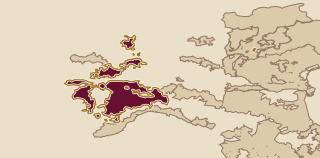
Monferrato is a broad Piedmont region of rolling hills between the Tanaro and Po rivers, south and east of the Langhe. Grazzano Badoglio, where Tenuta Santa Caterina farms, falls within the Asti province portion of Monferrato. The climate is continental, with warm summers and cold winters, and the soils shift between limestone, clay, and sand across the estate's parcels.
Nebbiolo grown in Monferrato carries a different character from the grape as it appears in Barolo or Barbaresco, which are cultivated on the Alba-centred Langhe hills to the west. Monferrato Nebbiolo is not subject to the tight appellation rules that govern those two zones. Before 2019, local regulations actively prevented producers from putting the word Nebbiolo on a Monferrato label at all. That regulatory peculiarity shaped how the estate named its flagship wine.
In the cellar
Vineyards and cellar
Vineyard work across the estate follows the same organic programme: organic fertilisers, mechanical weed control, green harvesting to reduce crop load and concentrate the remaining fruit, leaf stripping to improve air circulation and phenolic development, and hand-picking for small parcels. The aim is to arrive at the cellar with ripe, clean grapes without synthetic intervention at any stage.
Fermentation uses indigenous yeasts only, which means slower, less predictable ferments but a closer relationship between the vineyard's microbial character and the finished wine. The estate ages wines in both French oak barriques and large Slavonian oak botti. The combination allows the winemaking team to choose the degree of oak influence by vessel: barriques for wines that benefit from tighter grain and more exchange with the wood, the large botti for wines where the oak role is more neutral and the fruit and tannin are the primary signals.
Wines to know
The range in view
The range covers six varieties. Grignolino, Freisa, and Barbera are the three native Piedmont reds alongside Nebbiolo. Grignolino is a pale, high-acid, light-tannic red with bitter almond and rose hip on the finish; it is a Monferrato speciality that rarely travels far from the region. Freisa, also native to Piedmont, produces a darker, more structured wine with pronounced tannin and sour cherry. Barbera, the workhorse of Asti and Alba, tends toward deep colour, low tannin, and bright acidity and is food-friendly at almost any age.
Chardonnay and Sauvignon Blanc complete the estate range. Both varieties have a long enough history in the Monferrato hills to count as established rather than experimental.
A useful way in
A bottle to begin with
Begin with Illegale. It is a Nebbiolo from the south-facing Rombi vineyard, fermented with indigenous yeasts, aged for twelve months in large Slavonian botti, and rested for six months in bottle before release. The limestone soils give the wine aromatic lift; the large-format oak leaves the grape's character in front. In the glass the tannin is firm and drying, the acidity keeps the fruit from feeling flat, and the finish has the grip that Nebbiolo needs to develop over time. It is not a wine for immediate softness, but it is clear and well-framed from the first pour, and it communicates what this estate is farming and why the Rombi parcel matters.