
Why it matters
The producer
For four decades, Tenuta Sette Ponti made nothing. Its vineyards produced grapes that left the property and became other people's wine. That changed in 1998 when Antonio Moretti, who had recently inherited the estate from his father, released Crognolo: a single red, named after a wild cornus bush growing on the land, and the first bottle to carry the Sette Ponti name.
The estate sits in the Valdarno, the wide valley of the Arno running between Florence and Arezzo. Its name means Seven Bridges, for the Roman viaducts that once crossed the river valley nearby. The Moretti family has held it since 1957, when architect Alberto Moretti bought the core property as a hunting retreat. The vineyards were there; winemaking was not. Antonio Moretti ended that arrangement. Crognolo came first. Oreno, a Bordeaux-variety blend and the estate's flagship, followed.
Place and vineyards
Where the wines begin
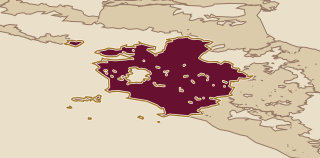
The Valdarno is not a named DOCG or a classified sub-zone. It is a geographical address: the valley floor and hillsides where the Arno flows between Florence and Arezzo in eastern Tuscany. Estates here typically release under the IGT Toscana designation, a label that allows freedom with grape varieties outside the historic Sangiovese appellations of Chianti Classico, Brunello di Montalcino, and Vino Nobile di Montepulciano.
That label choice is a consequence of the grape mix. Oreno, built from Merlot, Cabernet Sauvignon and Petit Verdot, cannot carry a DOCG name tied to Sangiovese. IGT Toscana gives the estate scope to work with the varieties it has chosen and to set its own agenda for ripeness, blend, and style.
In the cellar
Vineyards and cellar
The Sette Ponti estate farms 60 hectares of organic vineyards, a figure from the official estate. Organic farming here means no synthetic herbicides, pesticides or fertilisers in the rows. The Pratomagno breezes that move through the vineyards reduce the humidity that would otherwise make organic viticulture harder to sustain at this scale. Manual work covers pruning, canopy management, and harvest selection, each aimed at limiting yields and concentrating flavour in the fruit before it reaches the cellar.
Fermentation runs in temperature-controlled stainless steel, concrete and ceramic vessels, with natural fermentation encouraged. For Oreno, skin maceration lasts around 25 days with frequent pumpovers, a process that extracts colour, tannin and the aromatic compounds from the grape skins. Ageing follows in French oak barrels. The choice of vessel, barrique or large cask, varies by wine: Oreno ages in smaller French oak barriques.
Wines to know
The range in view
The estate produces two core red wines from the Valdarno.
Crognolo was the first release, vintage 1998, and carries the name of the cornus bush found growing wild on the property. It is the entry point into the range.
A useful way in
A bottle to begin with
Start with Oreno. It is built from 50% Merlot, 40% Cabernet Sauvignon and 10% Petit Verdot, farmed on the estate's organic vineyards at 200 to 300 metres, fermented with 25 days of skin contact, and aged in French oak barriques. The wine is dark and needs time: the tannins are firm in younger vintages, the acidity holds the mid-palate steady, and the finish is long enough to suggest a decade of development. A bottle three to five years after harvest will be opening; a bottle at eight to ten years will be fuller. This is the wine that sets Sette Ponti apart from the Valdarno's grape-selling past and places it alongside Tuscany's Bordeaux-variety estates.