
Why it matters
The producer
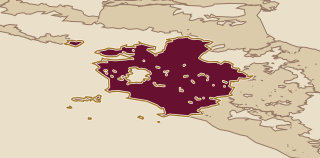
Tenuta Trerose sits at the far southeastern edge of the Vino Nobile di Montepulciano DOCG, where Tuscany runs out and Umbria begins. Lake Trasimeno is visible from the higher vineyard hills. Most buyers picture Montepulciano as a central Tuscan hilltop; Trerose occupies a quieter, more marginal corner of the appellation, and that position shapes what grows in the ground and what ends up in the glass.
The estate covers 200 hectares in total, with 103 hectares planted to vine. Its vineyards are distributed across five named hills: I Palazzi, Belvedere, Lodola, Poggetto and Santa Caterina. Almost the entire planting is Sangiovese in the local Prugnolo Gentile biotype, a form of Sangiovese historically associated with this corner of Tuscany that ripens to a particular density of fruit and firmness of tannin. Founded in 1982 and belonging to the Angelini Wines and Estates group, the estate is run today with enologist Andrea Lonardi overseeing the cellar.
Place and vineyards
Where the wines begin
Vino Nobile di Montepulciano is a DOCG centred on the town of Montepulciano in the province of Siena, at altitudes between roughly 250 and 600 metres on the ridges south of the Chiana Valley. Trerose's vineyards at Valiano di Montepulciano occupy the southeastern fringe of this zone, where the elevation is lower and the Umbrian border sits close enough that the landscape changes character within a few kilometres. The proximity to Lake Trasimeno introduces moisture from the east, which moderates the growing season and contributes to the freshness in the wines.
The soils across the five hills combine sandstone, clay rich in salt, and silt in varying proportions. The sandstone component promotes drainage and keeps vine roots active through the growing season. The clay retains moisture and minerals. The salt content in the clay is a local characteristic of this southeastern corner of the DOCG.
In the cellar
Vineyards and cellar
All 103 hectares are farmed organically since 2021, with integrated pest management as the preceding practice. Almost the entire planting is Prugnolo Gentile, the local Sangiovese biotype. Vine work across the five hills follows integrated pest management principles adapted to each site's drainage, aspect and soil character.
In the cellar, the approach diverges by wine tier. The estate Vino Nobile di Montepulciano ferments in temperature-controlled steel tanks over 18 days at 30 degrees Celsius, producing ripe extraction without over-working the grape. It then ages 18 months in Slavonian oak barrels followed by a minimum of four months in bottle. The Slavonian oak, typically in large format, adds a light oxidative note without dominating the Prugnolo fruit.
Wines to know
The range in view
The range is built around Prugnolo Gentile at every level and runs from entry Rosso di Montepulciano through three tiers of Vino Nobile, a rosé and a Vin Santo.
Rosso di Montepulciano DOC forms the entry tier, including the named Salterio. These are earlier-drinking wines designed to show Prugnolo in its less tannic register.
A useful way in
A bottle to begin with
Santa Caterina Vino Nobile di Montepulciano DOCG is the bottle to open first. It comes from a single hill, made entirely from Prugnolo Gentile, aged in large oak barrels for 18 months and then held in bottle for six years before it reaches the shelf. By the time it is released, the wine has resolved into a generous, fruit-forward expression of the grape: cherries in liqueur and myrtle on the nose, a plush and sweet palate, firm acidity, 14.5 percent alcohol, and a long finish. No tight tannins, no raw oak, no secondary complexity that needs further cellaring to be legible.