
Why it matters
The producer
Tenute Baldo Agricola is an Umbrian estate built around a deliberate split: 20 hectares at Montefalco, planted primarily to Sagrantino in the rolling hills south of Assisi, and 40 hectares at Torgiano on the gentler slopes to the north, producing both DOC and DOCG wines. The estate describes these two territories as twin centres, two souls of the same land. That framing is not merely rhetorical. Sagrantino and Sangiovese pull in different directions as grapes, and farming them separately under one project demands a cellar that can shift its approach depending on which fruit comes through the door.
The family team is Matteo as owner, Luca as oenologist, and Andrea as marketing lead. The tasting room sits in Bevagna, a medieval walled town positioned between the two vineyard zones, which makes it a natural meeting point for a project that spans both halves of the estate.
Place and vineyards
Where the wines begin
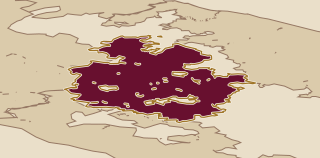
Umbria is landlocked and hilly, and its two red-wine appellations sit at different latitudes and elevations. Montefalco occupies higher, rougher ground south of Assisi, where Sagrantino, one of Italy's most tannic and extracted red grapes, reaches the phenolic ripeness it requires. The DOCG designation at Montefalco is built almost entirely around Sagrantino, and wines from this zone demand time in both barrel and bottle before the tannin softens enough to let fruit through.
Torgiano is lower and softer, its slopes gentler, its blending rules more flexible. The Torgiano Rosso Riserva DOCG allows Sangiovese as the dominant grape alongside Cabernet Sauvignon and Merlot, giving the winemaker more compositional latitude than Sagrantino permits. Bottles from Torgiano can carry weight and oak character while remaining more approachable at younger ages than a Montefalco Sagrantino. The appellation level matters on the label: the basic Torgiano DOC designation covers more immediate, lighter-bodied reds, while the Riserva DOCG requires extended ageing.
In the cellar
Vineyards and cellar
At Montefalco, Sagrantino is the primary variety. The grape requires extended hang time to achieve ripeness, and its naturally high tannin means cellar decisions around maceration length and wood format are consequential for whether the finished wine is drinkable within a reasonable window or locked up for years.
At Torgiano, the cellar divides production by appellation level. For Spirito della Vite, the Riserva DOCG, grapes undergo spontaneous fermentation without added commercial yeast, then macerate for 25 days at temperatures managed for the oenological objective. Malolactic fermentation completes in steel. The wine then spends 24 months in French barriques on fine lees, and a further 12 months in bottle before release. The long oak period is deliberate, and the estate's stated principle, that wood must not override fruit, means the target is integration rather than imposition.
Wines to know
The range in view
The range runs across two appellations and two appellation levels.
At Torgiano, Spirito della Vite (Torgiano Rosso Riserva DOCG) is the estate's Torgiano Rosso Riserva DOCG. Sangiovese leads the blend, with Merlot and Cabernet Sauvignon completing it. Twenty-five days of skin contact extracts colour, tannin, and fruit concentration. Two years in French oak builds texture and complexity; fine lees contact during that period softens the wine's edges. Twelve months in bottle before release means it arrives with some integration already in place, though the oak and tannin weight suggest further cellaring rewards it.
A useful way in
A bottle to begin with
Start with Spirito della Vite, Torgiano Rosso Riserva DOCG. It undergoes spontaneous fermentation, 25 days of maceration, 24 months in French barriques on fine lees, and 12 months in bottle before release. The grape base is Sangiovese with Merlot and Cabernet Sauvignon. In the glass, it is an oak-integrated red with dark fruit, firm acidity, and a long finish with tannin that asks for food or time. It is not a light wine, but the cellar's discipline around wood means the oak supports rather than dominates. Open it with lamb or hard aged cheese, or set a bottle aside for two to three years.