
Why it matters
The producer
Ca'Botta had its first qualifying harvest in 2009, young enough that the estate built its reputation without the inheritance of long classification history or established family prestige. What it built instead was a single consistent idea: every wine in the Valpolicella range comes from dried grapes, and the drying is done by a cellar method the estate developed, tested, and eventually patented.
The vineyards sit on a south west facing slope near Grezzana, between 380 and 520 metres above sea level, planted to Corvina Veronese, Corvinone, and Rondinella, the three indigenous grapes that define Valpolicella. An additional 5 hectares near Brescia grow Riesling. The estate commits its Valpolicella fruit entirely to appassimento production: Amarone at the top, two Ripasso wines below it, all made from grapes that have been harvested by hand and then dried in the cellar.
Place and vineyards
Where the wines begin
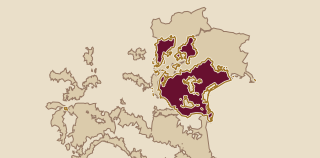
Valpolicella DOC occupies the hills west and north of Verona in Veneto, where Corvina Veronese, Corvinone, and Rondinella grow on slopes above the Adige plain. The appellation allows both fresh Valpolicella and the more concentrated dried grape styles: Amarone della Valpolicella DOCG, made entirely from appassimento fruit, and Ripasso DOC Superiore, refermented on dried grape skins.
Ca'Botta's parcels near Grezzana sit high within Valpolicella, at elevations that reach 520 metres. At that altitude, winds move consistently across the hillside. The estate uses those winds as part of its production logic: grapes harvested later on the slope carry more ripeness, and the air movement aids natural drying once the fruit reaches the cellar. The south west aspect means long afternoon sun, which concentrates sugars and ripeness while the elevation keeps enough acid in the grape to survive full maturation without losing freshness.
In the cellar
Vineyards and cellar
All 20 Valpolicella hectares are harvested by hand. After harvest, grapes move into the cellar for appassimento, the extended drying process that reduces water content in the fruit, concentrating sugars, tannins, and aromatics before fermentation begins. At Ca'Botta, drying happens under natural conditions, with altitude winds providing the air circulation that keeps the grapes healthy through the drying period.
Fermentation and maceration proceed through the Fermentino Ca'Botta method, the patented technique designed to extract tannins and phenolics from dried fruit more completely than standard approaches allow. Dried grapes have different physical characteristics than fresh ones: tighter skins, higher sugar concentration, lower free moisture. The Fermentino method addresses that altered starting material directly.
Wines to know
The range in view
The Ca'Botta range is built around three dried grape reds and a Riesling from the Brescia holding.
Cajo' Amarone della Valpolicella DOCG is the flagship. A dry red from 100% appassimento dried Corvina Veronese, Rondinella, and Corvinone, it is matured in 225 litre French barriques and bottled at 16% alcohol. The producer describes the wine as dense and highly concentrated, with an almost black colour. An independent review of the 2016 vintage scored it 90 to 91 out of 100, finding crushed cassis, blackberry, strawberry, and concentrated black fruit aromatics.
A useful way in
A bottle to begin with
Start with Cajo' Amarone della Valpolicella DOCG. It is a dry red from 100% appassimento dried Corvina Veronese, Rondinella, and Corvinone, matured in 225 litre French barriques and bottled at 16% alcohol. The 2016 vintage earned a score of 90 to 91 out of 100 and showed crushed cassis, blackberry, and concentrated black fruit character.